Link to the article http://www.msnbc.msn.com/id/21989183/
There was a report published by the United Nations Development Programme which stated the effects of global warming poorer countries around the world. Of course it stated all the dire consequences that emitting carbon dioxide has and how the poor women and children are going to be the most. This article is a summary of the report and it caught my attention because in the second paragraph it states that the U.S needs to cover $40 billion of the annual $86 billion needed to protect the poor in other countries. This report which I skimmed through says that the two major contributors of carbon dioxide emissions (the U.S and China) are responsible for the money needed to “strengthen the capacity of vulnerable people”.
So if I got this right this report commissioned by the UN wants the U.S government, the U.S citizens to pay for the damages that global warming causes to other countries. This payment is not too far off in the future ether. By 2012 it is estimated that the full $86 billion in “climate proofing” will be needed annually. This money will mostly be spent on flood and drought relief in poor countries around the world. Seems to me to be a little bit of a stupid idea to spend $86 billion every year on clean up rather than spend it on prevention of the “mess maker”. Hopefully after spending $86 billion for possibly a few years the “mess maker” could be contained and no more money need be spent instead of spending that money indefinitely. That is if humans have a significant impact on the “mess maker” global warming.
The 400 page report says a lot of nothing I think. If the UN embraces it though, nothing will still be done. The problem of putting in place some law to make the U.S pay the money is that there is no one to enforce it. The UN had no army or power to make other countries enforce it. The idea that this report has is a waste of time and caused more damage to the environment in the printing of its 400 pages than environmental protecting it would have caused if it was followed.
Friday, November 30, 2007


Ethanol Craze Cools as Doubts Multiply
Ethanol Craze Cools as Doubts Multiply
Wall Street Journal
It seems that the use of ethanol as a clean fuel source is under fire due to rising food price, the concern for straining our already dwindling water supply and the type of pollution caused by burning ethanol with gasoline. Ethanol is perceived to be the temporary solution to the United States oil dependence and is the cornerstone President Bush's plan to reduce use of foriegn oil. Currently, proponents of ethanol are pushing to have oil refiners blend more ethanol into gasoline but opponents from various food producers and livestock farmers are grabbing the attention of Congress as well.
Etter of the WSJ states, "the U.S. gives oil refiners an excise-tax credit of 51 cents for every gallon of ethanol they blend into gasoline. And even though it's the oil industry that gets this subsidy, the industry dislikes being forced to use a nonpetroleum product. The U.S. ethanol industry is further protected by a 54-cent tariff on every gallon of imported ethanol.The ethanol tax credit will bring refiners an estimated $3.5 billion this year"
Using ethanol gives oil refiners incentive to use the product but environementalists and energy experts are questioning the tradeoffs of ethanol use. They are mainly concerned with the use water and fertiliziers it takes to grow corn to produe ethanol.
Etter of the WSJ also states, "back in early 2005, President Bush gave ethanol a boost in his State of the Union speech by calling for "strong funding" of renewable energy. Energy legislation that summer required oil companies to blend a total of 7.5 billion gallons of "renewable" fuels into the nation's fuel supply by 2012. The legislation also effectively extinguished ethanol's chief competitor as a clean-burning additive, methyl tertiary-butyl ether, which had groundwater-pollution issues. The bill anointed ethanol as the default additive and instantly created demand nearly double what was produced that year."
By forcing the use of ethanol, the U.S. has artifically created a demand that they may not have anticipated to create the tough choice between energy security and food security.
Etter writes, "a study coauthored by Nobel-prize-winning chemist Paul Crutzen said corn ethanol might exacerbate climate change as the added fertilizer used to grow corn raised emissions of a very potent greenhouse gas called nitrous oxide. The ethanol industry replies to that one with an Energy Department study concluding that use of ethanol reduces greenhouse-gas emissions by 18% to 28% on a per-gallon basis, provided that coal isn't used to run ethanol plants.
Opponents of ethanol also have hammered on an Agriculture Department projection that by 2010, less than 8% of the U.S. gasoline supply will come from corn-based ethanol -- and 30% of the corn crop will be used to make it. That suggests to some that the tradeoff between food and fuel is unbalanced.
The government of Quebec, which has offered loan guarantees for corn ethanol plants, recently decided not to initiate any new ones. Instead it will turn its attention to so-called cellulosic ethanol, which would be made from switchgrass, wood chips or other plant matter. It concluded that "the environmental costs of corn ethanol are higher than expected," says a spokesman for the province's minister of natural resources."
It seems that there might be a better option to helping the environment through different fuel sources. The U.S. is trying to find that diamond in the rough to help combat the rising prices of oil. Ethanol seems to be the wrong answer for the fight against oil dependence. The U.S. may need to ditch the idea and look elsewhere ... perhaps the car that uses air pressure for an energy source or hydrogen fuel cells.
Wall Street Journal
It seems that the use of ethanol as a clean fuel source is under fire due to rising food price, the concern for straining our already dwindling water supply and the type of pollution caused by burning ethanol with gasoline. Ethanol is perceived to be the temporary solution to the United States oil dependence and is the cornerstone President Bush's plan to reduce use of foriegn oil. Currently, proponents of ethanol are pushing to have oil refiners blend more ethanol into gasoline but opponents from various food producers and livestock farmers are grabbing the attention of Congress as well.
Etter of the WSJ states, "the U.S. gives oil refiners an excise-tax credit of 51 cents for every gallon of ethanol they blend into gasoline. And even though it's the oil industry that gets this subsidy, the industry dislikes being forced to use a nonpetroleum product. The U.S. ethanol industry is further protected by a 54-cent tariff on every gallon of imported ethanol.The ethanol tax credit will bring refiners an estimated $3.5 billion this year"
Using ethanol gives oil refiners incentive to use the product but environementalists and energy experts are questioning the tradeoffs of ethanol use. They are mainly concerned with the use water and fertiliziers it takes to grow corn to produe ethanol.
Etter of the WSJ also states, "back in early 2005, President Bush gave ethanol a boost in his State of the Union speech by calling for "strong funding" of renewable energy. Energy legislation that summer required oil companies to blend a total of 7.5 billion gallons of "renewable" fuels into the nation's fuel supply by 2012. The legislation also effectively extinguished ethanol's chief competitor as a clean-burning additive, methyl tertiary-butyl ether, which had groundwater-pollution issues. The bill anointed ethanol as the default additive and instantly created demand nearly double what was produced that year."
By forcing the use of ethanol, the U.S. has artifically created a demand that they may not have anticipated to create the tough choice between energy security and food security.
Etter writes, "a study coauthored by Nobel-prize-winning chemist Paul Crutzen said corn ethanol might exacerbate climate change as the added fertilizer used to grow corn raised emissions of a very potent greenhouse gas called nitrous oxide. The ethanol industry replies to that one with an Energy Department study concluding that use of ethanol reduces greenhouse-gas emissions by 18% to 28% on a per-gallon basis, provided that coal isn't used to run ethanol plants.
Opponents of ethanol also have hammered on an Agriculture Department projection that by 2010, less than 8% of the U.S. gasoline supply will come from corn-based ethanol -- and 30% of the corn crop will be used to make it. That suggests to some that the tradeoff between food and fuel is unbalanced.
The government of Quebec, which has offered loan guarantees for corn ethanol plants, recently decided not to initiate any new ones. Instead it will turn its attention to so-called cellulosic ethanol, which would be made from switchgrass, wood chips or other plant matter. It concluded that "the environmental costs of corn ethanol are higher than expected," says a spokesman for the province's minister of natural resources."
It seems that there might be a better option to helping the environment through different fuel sources. The U.S. is trying to find that diamond in the rough to help combat the rising prices of oil. Ethanol seems to be the wrong answer for the fight against oil dependence. The U.S. may need to ditch the idea and look elsewhere ... perhaps the car that uses air pressure for an energy source or hydrogen fuel cells.
Is Acid Rain Killing Off Wood Thrushes?
http://news.nationalgeographic.com/news/2002/08/0813_020813_acidrain.html
A study from the Cornell Laboratory of Ornithology has named acid rain as the cause of the declining population of Wood Thrushes. This bird breeds in eastern
It seems that economic efficiency is the only realistic way to examine the apparent Wood Thrush dilemma. Our economy would certainly suffer from greater regulation of the Midwestern power plants in an attempt to save the Wood Thrush and other affected species. If action were taken and power plants and other polluting industries were more strictly regulated throughout the Midwest and eastern parts of the county then it seems likely that the costs incurred from lower outputs/less polluting outputs would get passed on to the consumer. If prices were pushed too high we certainly wouldn’t have achieved efficiency. It does seem unlikely that strenuous pollution legislation will be passed when considering the benefit to millions of people provided with power and other goods produced by polluting industries. Could it be that the market has already determined the efficient amount of acid rain causing pollutants? I would tend to think so considering the millions of Midwesterners (and probably Easterners) provided with power at a reasonable price at the cost of some amount of calcium in northeastern soils.
Thursday, November 29, 2007
More Leadership?
After a recent meeting on global climate change Ban Ki-moon Secretary General of the United Nations called for the United States and China to take "a more constructive role." After all they are the worlds biggest greenhouse gas emitters. This meeting took place before the IPCC was to meet in Indonesia. The IPCC report says we need to take action immediately in order to slow global warming. They also say that global climate change could have a catastrophic affect on the world if we don't act now; island nations could be flooded and deserted, African crops could be reduced by 50%. Many articles I have read says that the people most effected by climate change will be in developing nations. Developed nations will be able to adapt because a main portion of their economy depends on services not agriculture like developing nations. The IPCC also look to the U.S. and China for a quick solution. They want them so spend money on new technology so that the whole world can benefit from it. If the U.S and China were to do this it would have to be because they are going to benefit far greater than by not doing it. That is one reason, I believe, they are not taking any action. The Global Climate is a public good we can not exclude one country from it. To me this means the only way we are going to stop global warming we need a government that can enforce everyone not just put pressure. Another aspect I think that should be explored is developing nations. There is more incentive for them to take action since they are going to be the ones most harmed by climate change. Policy makers need to explore this possibility when writing treaties. This point might be a bit controversial but we would not ask them to do much; just something simple like cutting back on deforestation. When it comes to global warming everyone is looking for more leadership, but no one is wanting to take action. We can not leave this problem to be solved in the hands of two countries.
Tuesday, November 27, 2007
Yeah...I'm concerned about Global Warming!
http://www.nytimes.com/2007/11/10/science/earth/10geo.html
“We simply must do everything we can in our power to slow down global warming before it is too late. The science is clear. The global warming debate is over.” This quote about global warming did not come from a far left leaning democrat, but a moderate Republican, named Arnold Schwarzenegger. It seems today though that the debate continues on about global warming. This essay will try to shed some light on why the debate on this global crisis continues (my value judgment tells me that the debate should be over) and what can be done on economic level as well as a scientific level to reduce global warming when the debate concludes. So why does the debate continue on about global warming?
The debate continues not because most people reject the idea of global warming but because of two rather minor reasons. The first reason is that as a society we are not sure how to deal with global warming in way that that creates an efficient end result. Although we are not sure, I think that we should at least try something becasue we know that it exists and it is harming the population, I believe this to be fact, but you can take it as my value judgement. The second reason is that sometimes we simply choose not to address the issue, except for when it supplements an argument on another issue. We need to make Global Warming the issue not tip toe around it because it suits us; if we are able to move away from the debate around global warming then we might be able to start addressing the problem.
The most likely economic approach to dealing with global warming is creating a hybrid policy that creates a market, which includes elastic short-term permits along with, a specified number of long-term permits. The permits could be bought and sold or leased without restriction, and each one would allow the holder to emit one ton of carbon per year. Once distributed, the permits could be traded among firms or bought and retired by environmental groups. In addition, each government would be allowed to sell additional short-term permits for a specified fee. The hybrid plan thus combines the key advantages of tax and permit policies. Like a tax, it places an upper limit on the marginal cost of abatement, and the hybrid policy also avoids many of the distributional issues of an emissions tax.
Now moving from an economic approach to solve global warming to a scientific one, one such idea is injecting chemicals into the upper atmosphere to cool the poles, or blocking sunlight by making clouds more reflective or stationing mirrors in space. However, consequences of planetary engineering that cannot be anticipated may be serious and even harm the earth. Hopefully, at the very least the discussion about geo-engineering will finally sound an 'audible alarm' for others.
On one subject, though, there was wide agreement: interest in geo-engineering is no longer merely theoretical. The participants in the conference noted that global emissions of greenhouse gases were already moving above the upper limits predicted by many climate models. As a result, several said, the projected arrival of ice-free summers in the Arctic Ocean has shifted, in a few years, from 2100 to 2040 to 2013. And survival estimates are changing for the Greenland ice sheet, whose melting would cause a potentially devastating rise in sea levels. Once estimated in terms of millenniums, they are now expressed in estimates of only mere decades. It is time for something to be done, I’d rather we respond to this crisis now using an excise tax on global emissions, than geo-engineering, but at this point I am willing to try anything…
“We simply must do everything we can in our power to slow down global warming before it is too late. The science is clear. The global warming debate is over.” This quote about global warming did not come from a far left leaning democrat, but a moderate Republican, named Arnold Schwarzenegger. It seems today though that the debate continues on about global warming. This essay will try to shed some light on why the debate on this global crisis continues (my value judgment tells me that the debate should be over) and what can be done on economic level as well as a scientific level to reduce global warming when the debate concludes. So why does the debate continue on about global warming?
The debate continues not because most people reject the idea of global warming but because of two rather minor reasons. The first reason is that as a society we are not sure how to deal with global warming in way that that creates an efficient end result. Although we are not sure, I think that we should at least try something becasue we know that it exists and it is harming the population, I believe this to be fact, but you can take it as my value judgement. The second reason is that sometimes we simply choose not to address the issue, except for when it supplements an argument on another issue. We need to make Global Warming the issue not tip toe around it because it suits us; if we are able to move away from the debate around global warming then we might be able to start addressing the problem.
The most likely economic approach to dealing with global warming is creating a hybrid policy that creates a market, which includes elastic short-term permits along with, a specified number of long-term permits. The permits could be bought and sold or leased without restriction, and each one would allow the holder to emit one ton of carbon per year. Once distributed, the permits could be traded among firms or bought and retired by environmental groups. In addition, each government would be allowed to sell additional short-term permits for a specified fee. The hybrid plan thus combines the key advantages of tax and permit policies. Like a tax, it places an upper limit on the marginal cost of abatement, and the hybrid policy also avoids many of the distributional issues of an emissions tax.
Now moving from an economic approach to solve global warming to a scientific one, one such idea is injecting chemicals into the upper atmosphere to cool the poles, or blocking sunlight by making clouds more reflective or stationing mirrors in space. However, consequences of planetary engineering that cannot be anticipated may be serious and even harm the earth. Hopefully, at the very least the discussion about geo-engineering will finally sound an 'audible alarm' for others.
On one subject, though, there was wide agreement: interest in geo-engineering is no longer merely theoretical. The participants in the conference noted that global emissions of greenhouse gases were already moving above the upper limits predicted by many climate models. As a result, several said, the projected arrival of ice-free summers in the Arctic Ocean has shifted, in a few years, from 2100 to 2040 to 2013. And survival estimates are changing for the Greenland ice sheet, whose melting would cause a potentially devastating rise in sea levels. Once estimated in terms of millenniums, they are now expressed in estimates of only mere decades. It is time for something to be done, I’d rather we respond to this crisis now using an excise tax on global emissions, than geo-engineering, but at this point I am willing to try anything…
Monday, November 26, 2007
Carbon Tax vs. Cap-and-Trade
Summary of the Article
Most people agree that reducing carbon emissions will aid in solving to so-called problem of global warming. The only problem is that a tax would be required to incentivize people to reduce the amount of carbon emissions they commit. Capitol Hill would rather set caps on greenhouse-gas emissions (with allowances to trade emission permits) and tighten up regulations, such as fuel-economy standards than develop a tax for carbon emissions. A few problems with cap-and-trade plans, as evidenced by other nations, are that they take a long time to set up and perfect and raise energy prices for consumers, however, not as directly as a tax.
Carbon Taxes and Incentives
A carbon tax would send a signal to the market to reduce carbon use. In addition, the tax would provide an incentive for research and investment into renewable sources. The article suggests that tax revenues could be returned to taxpayers. For example, “every worker would receive a tax rebate of about $560, cutting the tax bill by 18% for those earning $20,000, or by 4% for those earning $90,000.” In addition, carbon taxes will assist in predicting energy prices. There is urgency in solving the climate crisis, such as global warming. Carbon taxes can be implemented quicker than the cap-and-trade system.
Furthers problems of Cap-and-Trade
A cap-and-trade system is an administrative approach used by a central body, such as the government, to control pollution using economic incentives for achieving reductions in the amount of emissions of pollutants, such as carbon. Unlike the transparency of carbon taxes, the cap-and-trade system is harder for business to predict because of constant fluctuations. The costs of cap-and-trade are very high. The costs are for implementation and for the improvement in technology that would cut carbon emissions. These costs will likely be passed onto consumers with less possibility of a tax shift that the carbon tax could offer.
Conclusion
In conclusion, carbon taxes will be more efficient in reducing carbon emissions. They will be more efficient because nobody likes a tax. Therefore, the greater the chance of being taxed, the more incentive there will be to take responsibility in reducing the amount of carbon emissions.
Sunday, November 25, 2007
The standout crowd no longer standing out!
Well it seems as though the final frontier may have been reached. According to a recent article found on MSN.com, the long standing climate change apathetic Evangelical Christian demographic is tossing its chips in on the climate change camp. The article details how a sudden shift in evangelical thought surrounding climate change could have a drastic impact on the way this large demographic votes in the coming election.
As a christian myself, I find this rather interesting. For years... strike that... forever, the Christian Church has been rebuking and battling science on everything from birth control to evolution. Now, for some reason, on a topic that a fair portion of the secular audience would say is fallable at best, the Christian demographic seems to be jumping ship and running with science.
Should predictions be correct about the number of evangelical Christians now voting with climate change in mind, there are two very important implications that come as a result of this. First, if the climate change skeptical crowd wants to have any chance at slowing hasty policy making decisions, it better act now! Even those that we would expect to not vote based on climate change policy are beginning to vote that way. There are very few people left still have an unbiased view.
Second, this goes to show the power that the global warming campaign has had. It's a very multifaceted campaign that's now been able to morph itself into a biblical context to grab the attention of perhaps the most key demographic. Furthermore, the momentum that global warming policy would pickup as a result of gaining the large evangelical demographic would be huge.
If indeed it is the case that the sudden shift of thought among christians has really happened, then it would represent a major hurdle crossed for those with incentive interests in passing global warming policy. Personally, I see it as a majore hurdle lost in slowing down this paranoia freight train.
As a christian myself, I find this rather interesting. For years... strike that... forever, the Christian Church has been rebuking and battling science on everything from birth control to evolution. Now, for some reason, on a topic that a fair portion of the secular audience would say is fallable at best, the Christian demographic seems to be jumping ship and running with science.
Should predictions be correct about the number of evangelical Christians now voting with climate change in mind, there are two very important implications that come as a result of this. First, if the climate change skeptical crowd wants to have any chance at slowing hasty policy making decisions, it better act now! Even those that we would expect to not vote based on climate change policy are beginning to vote that way. There are very few people left still have an unbiased view.
Second, this goes to show the power that the global warming campaign has had. It's a very multifaceted campaign that's now been able to morph itself into a biblical context to grab the attention of perhaps the most key demographic. Furthermore, the momentum that global warming policy would pickup as a result of gaining the large evangelical demographic would be huge.
If indeed it is the case that the sudden shift of thought among christians has really happened, then it would represent a major hurdle crossed for those with incentive interests in passing global warming policy. Personally, I see it as a majore hurdle lost in slowing down this paranoia freight train.
Monday, November 19, 2007
china's three gorges dam
China is quickly becoming one of the world’s leading polluters. Recently, Chinese air pollution has been known to travel up to 3,000 miles away and can be found blowing in to American coastal cities like San Francisco and Los Angeles (http://www.pbs.org/wgbh/nova/transcripts/3109_worldbal.html).
With a huge percentage of its population moving from rural areas with no electricity or running water into an urban environment for job opportunities, China’s government is struggling to keep up with the infrastructure necessary to accommodate the influx. Coal burning for electricity is the current source of most of China’s energy at present, but the government is making an effort to provide more efficient ways to supply the changing population’s need for energy.
One of the alternatives being implemented is harnessing the massive Yangtze River’s currents by building dams to supply hydroelectric power. These dams will drastically change the environments around the river. Also, these large projects involve relocating an estimate 11 million rural people away from the river because of rising waters upstream.
The Three Gorges Dam is getting criticism from environmentalists and economists alike. The former point out the poor environmental planning that went into the project from the start. The river has seen garbage and silt accumulation behind the dam, fertilizer runoff from the flooded land formerly used for agriculture, and no planned infrastructure to remediate the environmental damage. Economically, the Gorge project is costing China much more than many think it is worth. The Dam’s price includes the dam itself, relocating the shore-dwelling people by offering them subsidies and cash rewards to move to the city, and remediating the unplanned for environmental issues, while ensuring they don’t happen in the future.
China’s Three Gorges Dam is an interesting case study on a developing country struggling to meet its energy needs. The growing pains are lessons for everyone.
Link to Wall Street Journal Article:
http://online.wsj.com/article_email/SB119429475928882924-lMyQjAxMDE3OTE0MTIxOTE0Wj.html
Link to accompanying video:
http://link.brightcove.com/services/player/bcpid452319854?bctid=1287035232
With a huge percentage of its population moving from rural areas with no electricity or running water into an urban environment for job opportunities, China’s government is struggling to keep up with the infrastructure necessary to accommodate the influx. Coal burning for electricity is the current source of most of China’s energy at present, but the government is making an effort to provide more efficient ways to supply the changing population’s need for energy.
One of the alternatives being implemented is harnessing the massive Yangtze River’s currents by building dams to supply hydroelectric power. These dams will drastically change the environments around the river. Also, these large projects involve relocating an estimate 11 million rural people away from the river because of rising waters upstream.
The Three Gorges Dam is getting criticism from environmentalists and economists alike. The former point out the poor environmental planning that went into the project from the start. The river has seen garbage and silt accumulation behind the dam, fertilizer runoff from the flooded land formerly used for agriculture, and no planned infrastructure to remediate the environmental damage. Economically, the Gorge project is costing China much more than many think it is worth. The Dam’s price includes the dam itself, relocating the shore-dwelling people by offering them subsidies and cash rewards to move to the city, and remediating the unplanned for environmental issues, while ensuring they don’t happen in the future.
China’s Three Gorges Dam is an interesting case study on a developing country struggling to meet its energy needs. The growing pains are lessons for everyone.
Link to Wall Street Journal Article:
http://online.wsj.com/article_email/SB119429475928882924-lMyQjAxMDE3OTE0MTIxOTE0Wj.html
Link to accompanying video:
http://link.brightcove.com/services/player/bcpid452319854?bctid=1287035232
Thursday, November 08, 2007
Inner Economist
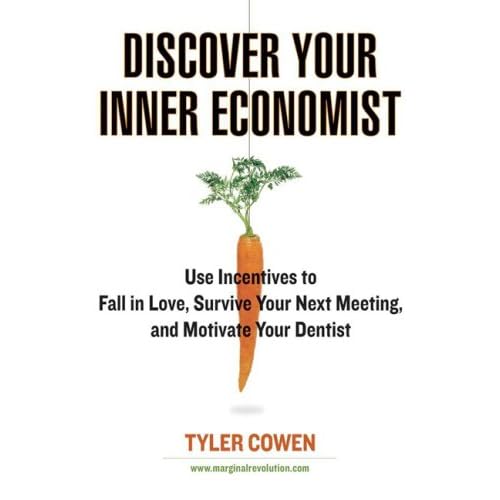 If you are looking for a winterim course, then you might be interested in my Econ 398 Inner Economist. Maybe another title for this course would be "Economics For My Life." The course will involve reading two books: (1) Tyler Cowen, Discover Your Inner Economist: Use Incentives to Fall in Love, Survive Your Next Meeting, and Motivate Your Dentist, and (2) Tim Harford, The Undercover Economist: Exposing Why The Rich Are Rich, The Poor Are Poor -- And Why You Can Never Buy A Decent Used Car! The course will culminate with a set of assignments suggested by The Economic Naturalist. Perhaps a better title for the course would be: "Economics for My Life." You could almost expect to find this stuff in the "self help" section of your favorite bookstore.
Wednesday, November 07, 2007
Gore the Pure
Environmental support comes at a cost- Gore the Pure
“Nobel laureate Al Gore is unlikely to run (for Presidency) again. His Ideas are catching on, but people still don’t want to pay for them.”
One man who seems to always gain media attention is the former vice president, Al Gore. He is a main proponent of many controversial issues that have an impact on environmental economics. Global warming is one concern for many Americans that is gaining recognition. “The proportion of Americans who say they worry ‘a great deal’ about global warming has risen from 28% to 41% in the past four years. Over the same period, the proportion favoring ‘immediate, drastic action’ to protect the environment has risen from 23% to 38%.” Where these percentages came from is not listed in the article, but it raises the questions regarding why there is a sudden concern about the environment. Clearly changes that are made regarding America’s use of energy and emissions will have an impact on the nation’s economy. For the 2008 election it seems that candidates will have to take some sort of stand on what type of policy they will enforce regarding the environment because it is a hot issue that is not going away any time soon.
… no plausible candidate of either party favours a carbon tax, the most efficient way to tackle emissions… Voters prefer solutions that are either cheap or that they thing will be paid for by someone else. A poll for the New Scientist magazine in June tried to quantify this, with sobering results. Only half of Americans would favour rules to force power companies to emit less if that raised their monthly electricity bill from $85 9the average in 20050 to $155 (an estimate of the hike needed to lower American emissions by 5% by 2020). And only 37% could stomach a tax that raised petrol (gasoline) prices to $4 a gallon.
Given these results from the poll it is hard to imagine that any candidate will garner much support if they support making changes such as the ones given as examples above. “You cannot win the White House by telling Americans that they must pay more to drive, or by telling Midwestern coalminers that their industry must clean up or die.” Although it is not certain whether there is really a significant climate change, or global warming, the issue has consumed a substantial portion of media attention and will be addressed politically and have wide reaching economic effects.
JENNA CLULEY
Source: http://www.economist.com/research/articlesBySubject/PrinterFriendly.cfm?story_id=998...
“Nobel laureate Al Gore is unlikely to run (for Presidency) again. His Ideas are catching on, but people still don’t want to pay for them.”
One man who seems to always gain media attention is the former vice president, Al Gore. He is a main proponent of many controversial issues that have an impact on environmental economics. Global warming is one concern for many Americans that is gaining recognition. “The proportion of Americans who say they worry ‘a great deal’ about global warming has risen from 28% to 41% in the past four years. Over the same period, the proportion favoring ‘immediate, drastic action’ to protect the environment has risen from 23% to 38%.” Where these percentages came from is not listed in the article, but it raises the questions regarding why there is a sudden concern about the environment. Clearly changes that are made regarding America’s use of energy and emissions will have an impact on the nation’s economy. For the 2008 election it seems that candidates will have to take some sort of stand on what type of policy they will enforce regarding the environment because it is a hot issue that is not going away any time soon.
… no plausible candidate of either party favours a carbon tax, the most efficient way to tackle emissions… Voters prefer solutions that are either cheap or that they thing will be paid for by someone else. A poll for the New Scientist magazine in June tried to quantify this, with sobering results. Only half of Americans would favour rules to force power companies to emit less if that raised their monthly electricity bill from $85 9the average in 20050 to $155 (an estimate of the hike needed to lower American emissions by 5% by 2020). And only 37% could stomach a tax that raised petrol (gasoline) prices to $4 a gallon.
Given these results from the poll it is hard to imagine that any candidate will garner much support if they support making changes such as the ones given as examples above. “You cannot win the White House by telling Americans that they must pay more to drive, or by telling Midwestern coalminers that their industry must clean up or die.” Although it is not certain whether there is really a significant climate change, or global warming, the issue has consumed a substantial portion of media attention and will be addressed politically and have wide reaching economic effects.
JENNA CLULEY
Source: http://www.economist.com/research/articlesBySubject/PrinterFriendly.cfm?story_id=998...
Captain Planet
I hate captain planet.
Well, not him per se, but more what the cartoon represents. Captain Planet is a subversive piece of propaganda Joseph Goebbels would be proud of. It teaches innocent children to ignore economic reality. Villains are persons (sometimes less than so) who share two things in common; an unexplained hate for the earth and a desire to make profits. Of course, the real villain is the idea that profits are mutually exclusive from a healthy environment.
Unfortunately for captain planet and his band of multicultural teenagers, people making profits by voluntary transaction is the most “environmentally friendly” social structure. The almost instant rejection of unregulated markets by the common man is simply a sign of how successful captain planet was in polluting minds. This may also be why a former founder of green peace recently wrote a book detailing the organizations hijack by anti-capitalists, not concerned environmentalists. The danger, like many things, comes in the form of common opinion.
Averagely intelligent and poorly educated people are easily manipulated. If one can convince another that exchange (free markets) hurts the environment, it doesn't become a far leap for one to dissuade exchange simply by accusing someone else of not loving the environment. Echoes of “think of the children” and “save the whales” comes to mind in a hauntingly comical fashion. Captain Planet is simply a graphical “think of the children” no less tiresome, but certainly more stylish (red spedos are STILL in)
Alexander Devore
Well, not him per se, but more what the cartoon represents. Captain Planet is a subversive piece of propaganda Joseph Goebbels would be proud of. It teaches innocent children to ignore economic reality. Villains are persons (sometimes less than so) who share two things in common; an unexplained hate for the earth and a desire to make profits. Of course, the real villain is the idea that profits are mutually exclusive from a healthy environment.
Unfortunately for captain planet and his band of multicultural teenagers, people making profits by voluntary transaction is the most “environmentally friendly” social structure. The almost instant rejection of unregulated markets by the common man is simply a sign of how successful captain planet was in polluting minds. This may also be why a former founder of green peace recently wrote a book detailing the organizations hijack by anti-capitalists, not concerned environmentalists. The danger, like many things, comes in the form of common opinion.
Averagely intelligent and poorly educated people are easily manipulated. If one can convince another that exchange (free markets) hurts the environment, it doesn't become a far leap for one to dissuade exchange simply by accusing someone else of not loving the environment. Echoes of “think of the children” and “save the whales” comes to mind in a hauntingly comical fashion. Captain Planet is simply a graphical “think of the children” no less tiresome, but certainly more stylish (red spedos are STILL in)
Alexander Devore
Hawaii's Growing Pains
Since becoming a state in 1959, Hawaii has grown substantially. The main area of growth has been in the tourism industry. According to an article posted to “The Economist” online on September 20, 2007, some people believe that the tourism industry in Hawaii is eroding natural resources, the local culture and the infrastructure. The latest addition to the tourism industry connects the busiest island with two smaller and less crowded ones, Kauai and Maui.
Tourists in Hawaii last month witnessed an unusual display of marine life: not sea turtles or a rare monk seal, but a line of surfers and swimmers preventing a ferry from docking at Kauai. The Superferry is the first big passenger boat to link Oahu, Hawaii’s most crowded island, to two less developed ones, Kauai and Maui. Some say such a link is sorely needed. But critics object that the ferry, which can hold more than 800 people, may interfere with whales and other wildlife, and worry about the asses traffic, fishermen and cheap labor it will bring.
Hawaii is currently one of the most expensive states to live in and also to do business in. With high levels of tourism and vacationers, there are also high rental and living costs. By creating a new route for tourism via the new ferry they are creating an increase in building high priced vacation homes for tourism, and possibly making the current cost of living more expensive for people who already live there. New building of homes and businesses will also diminish the amount of open space on the islands. The problem is two fold. There is a creation of new jobs and possibly some new industry, but it comes at the expense of higher prices and less open land. Some people suggest that a better way of encouraging economic growth is by encouraging more agriculture which is often very environment friendly. Others would contend that the best way to protect the land is to ensure that it is developed it in an efficient way. In considering the issue and growth it is important to look at the environmental implications. Too much tourism over time will certainly have negative and positive effects on the state as a whole. What is the best way to deal with the growth that will allow for more growth over time and not have significant negative long term effects?
On September 22, 2007 a group of civic and political leaders are meeting for the “Hawaii 2050 Sustainability Summit” to determine a long-term growth plan. Many people are at odds on the issue, but it is obvious that there is not just one simple solution to the problem.
http://www.economist.com/research/articlesBy Subject/cfm?storyid=9833
Jenna Cluley
Tourists in Hawaii last month witnessed an unusual display of marine life: not sea turtles or a rare monk seal, but a line of surfers and swimmers preventing a ferry from docking at Kauai. The Superferry is the first big passenger boat to link Oahu, Hawaii’s most crowded island, to two less developed ones, Kauai and Maui. Some say such a link is sorely needed. But critics object that the ferry, which can hold more than 800 people, may interfere with whales and other wildlife, and worry about the asses traffic, fishermen and cheap labor it will bring.
Hawaii is currently one of the most expensive states to live in and also to do business in. With high levels of tourism and vacationers, there are also high rental and living costs. By creating a new route for tourism via the new ferry they are creating an increase in building high priced vacation homes for tourism, and possibly making the current cost of living more expensive for people who already live there. New building of homes and businesses will also diminish the amount of open space on the islands. The problem is two fold. There is a creation of new jobs and possibly some new industry, but it comes at the expense of higher prices and less open land. Some people suggest that a better way of encouraging economic growth is by encouraging more agriculture which is often very environment friendly. Others would contend that the best way to protect the land is to ensure that it is developed it in an efficient way. In considering the issue and growth it is important to look at the environmental implications. Too much tourism over time will certainly have negative and positive effects on the state as a whole. What is the best way to deal with the growth that will allow for more growth over time and not have significant negative long term effects?
On September 22, 2007 a group of civic and political leaders are meeting for the “Hawaii 2050 Sustainability Summit” to determine a long-term growth plan. Many people are at odds on the issue, but it is obvious that there is not just one simple solution to the problem.
http://www.economist.com/research/articlesBy Subject/cfm?storyid=9833
Jenna Cluley
Tuesday, November 06, 2007
High cost for Environmentalism
Today in class we discussed the importance of the environment to many in the class. Our discussion seemed to also bring some skepticism to the global warming information presented.
As I have mentioned before, I subscribe to Bruce Yandle's theory of Bootleggers and Baptists. He has written a paper discussing this theory with regards to the environment, in particular the Kyoto Protocol. Thinking about what Yandle mentions about carbon trading and other "trading" occurring because of the treaty got me thinking about how many of my fellow classmates will be willing to pay more for reducing global climate change. Since it will be governments "trading" with one another to satisfy the protocol, and the governments will need to have revenue in order to make some of the arrangements, taxes will need to increase.
So my question for my fellow students is this: How much are you willing to pay to reduce "climate change". And, according to the link I have to Environmental Economics, which states that more than half did not pay anything for the album, how will they feel when they have to pay for my share, should I choose not to pay. What if you don't agree with all of the policy the government, are you still going to pa the tax?
Just a thought.
As I have mentioned before, I subscribe to Bruce Yandle's theory of Bootleggers and Baptists. He has written a paper discussing this theory with regards to the environment, in particular the Kyoto Protocol. Thinking about what Yandle mentions about carbon trading and other "trading" occurring because of the treaty got me thinking about how many of my fellow classmates will be willing to pay more for reducing global climate change. Since it will be governments "trading" with one another to satisfy the protocol, and the governments will need to have revenue in order to make some of the arrangements, taxes will need to increase.
So my question for my fellow students is this: How much are you willing to pay to reduce "climate change". And, according to the link I have to Environmental Economics, which states that more than half did not pay anything for the album, how will they feel when they have to pay for my share, should I choose not to pay. What if you don't agree with all of the policy the government, are you still going to pa the tax?
Just a thought.
Thursday, November 01, 2007
Pros and Cons of a sharp shift in supply.
In Norway, negotiations have begun on the assigning of drilling rights for oil off of the Norweigian continental shelf.
Environmental groups, however are opposed to this drilling, they would be opposed to any damaging of the environment. They are veheimently opposed to any drilling there whatsoever.
Perhaps these environmentalists prohibitions of new oil production can bring about change moe quickly.
As more and more of the world is the developed and drilled,the amount of untainted land lessens and lessens. Presumably, as this happens, the nvironmentalists will be more and more passionate in their efforts to stop further drilling and development. Put in Economic terms, of the law of demand, as the quantity of natural, untouched land decreases, price (or the lenghths to which enironmentalists would go) for this land increases. If environmentalists increasing efforts hamper and slow the finding of oil, then supply in oil will drop more and more rapidly, raising costs. This will lower the opportunity cost of finding new forms of non-oil energy, potentially quickening the process.
So as tree-huggers increase the implicit cost of oil, production of new fuels may speed.
I say: Hug on, Treehuggers!
Environmental groups, however are opposed to this drilling, they would be opposed to any damaging of the environment. They are veheimently opposed to any drilling there whatsoever.
Perhaps these environmentalists prohibitions of new oil production can bring about change moe quickly.
As more and more of the world is the developed and drilled,the amount of untainted land lessens and lessens. Presumably, as this happens, the nvironmentalists will be more and more passionate in their efforts to stop further drilling and development. Put in Economic terms, of the law of demand, as the quantity of natural, untouched land decreases, price (or the lenghths to which enironmentalists would go) for this land increases. If environmentalists increasing efforts hamper and slow the finding of oil, then supply in oil will drop more and more rapidly, raising costs. This will lower the opportunity cost of finding new forms of non-oil energy, potentially quickening the process.
So as tree-huggers increase the implicit cost of oil, production of new fuels may speed.
I say: Hug on, Treehuggers!
Wednesday, October 31, 2007
Why Oil May Not Stop at $100
Neil King, Jr. who wrote an WSJ article stating that after an energy conference , several leading oil experts claiming that oil may go past the $100 mark per barrel due to shrinking supply and higher global demand. These oil experts state that new pockets of oil are harder to reach and more expensive to tap. Yet, two members of OPEC tend to disagree. They assert that the falling dollar is contributing factor in rising oil prices while many of the theories presented at the this year's Oil & Money conference stated that there could be many reasons as to why oil prices are so high. It's hard to pinpoint a single cause.
One concern and possible theory that oil prices are so high is that fact that a lot of production in the Middle East is done fron mature oil reserves. These oil reserves are about 41% depleted and may cause a 15 year production plateau. There are more reserves in the wait but to get to them in time would be very costly and may not be possible due to technology and lack of funding.
OPEC officials have aggressively struck down the notion that they are to blame for the high prices by insisting that the market has more control over oil than OPEC.
With 2/3 of the world's oil coming from OPEC, consumers can hardly discern whether oil prices are set by OPEC or by other factors, such as geopolitics, currencies and/or financial investments within the industry. With the Gulf of Mexico and the North Sea reserves helping to ease the control that OPEC may have thought they exuded over oil prices, these prices, like everything else, have more than just one factor to determine how the price is set. With the dollar falling, that may be a bigger factor to oil prices than OPEC.
One concern and possible theory that oil prices are so high is that fact that a lot of production in the Middle East is done fron mature oil reserves. These oil reserves are about 41% depleted and may cause a 15 year production plateau. There are more reserves in the wait but to get to them in time would be very costly and may not be possible due to technology and lack of funding.
OPEC officials have aggressively struck down the notion that they are to blame for the high prices by insisting that the market has more control over oil than OPEC.
With 2/3 of the world's oil coming from OPEC, consumers can hardly discern whether oil prices are set by OPEC or by other factors, such as geopolitics, currencies and/or financial investments within the industry. With the Gulf of Mexico and the North Sea reserves helping to ease the control that OPEC may have thought they exuded over oil prices, these prices, like everything else, have more than just one factor to determine how the price is set. With the dollar falling, that may be a bigger factor to oil prices than OPEC.
Man slain by government lawn watering restrictions
OK, well maybe not just like that but factual errors and sensationalism are instep with the news. Anyways, according to CNN a 66-year-old man was killed while watering his lawn after a physical confrontation with a 36-year-old man. The two were arguing about SYDNEY, Australia's watering restrictions. Two things are striking, how someone watering their lawn can lead to murder and that a third of the article on CNN is about if the old man was right in watering his lawn at that time.
“I killed the last man who watered his lawn before 5.” Might be the new motto of our next generation of prison birds. Attacking someone on their own property is usually indicative of a strong motive, maybe its to steal their chain, maybe you are a contract killer, maybe you want to enforce water regulations. Who knows? Arguing about water regulation shows a deep commitment to upholding the regulation itself.
“The victim was complying with Sydney's water restrictions when he was killed.” well, that was a close call, for a second I thought this might just be a case of self-defense on apart of the young man. I mean, if water use isn't planned than we would run out of water and humans cant live without water.
The underlying message of this article is that without government intervention in resources we would be utterly lost. It ignores that prices communicate knowledge of scarcity. If water is more scarce prices increase and the opportunity cost of using water goes up. This is just one of many examples illustrating how most people are completely retarded.
A Greener California
Automobile enthusiasts around the country have dubbed California legislators as the “Emissions Nazis.” California legislators earned this nickname because in 2002 they passed laws that greatly restrict the emissions of automobiles. They also require that, by 2016, car manufacturers must reach a 30% reduction in emissions in their vehicles to sell them in California. The opponents (car manufacturers) claim that this is unfair because federal law says that it is up to the National Highway Traffic Safety Administration to set gas mileage standards. California legislators reacted to this by saying that they are not regulating fuel economy; rather they are controlling air pollution for the good of their people.
I think that California is well within their right to limit air pollution in their state. However, I do think that what legislators are doing is ridiculous. I grew up in New York City, and was both there, and in California, this past summer. I did not feel any healthier in California than in NYC. In fact, I did not notice any difference, whatsoever, in air quality. If the legislators actually had a way to measure air pollution, and determined that pollution from automobiles was harming their population then their emissions rules would be justified. However, I have never heard to people living healthier in California than in other states. However, I have heard that people will pay more for cars in California. And this is not just hear-say, this is a fact. In order to comply with emissions standards by the year 2016, consumers will most likely have to purchase vehicles such as hybrids. These vehicles are much more expensive than comparable, non-hybrid, cars. In a nutshell, what will happen is people will spend several thousand dollars more for a low emissions car, and never really see any benefits. In this case, California’s use of command and control policy, is providing no benefits to its population and will eventually cause them to have to spend more hard-earned money on cars.
IHS Essay Contest
The Institute for Humane Studies has an essay contest you might be interested in. You can find the information on the contest here. The topic is: What factors lead to prosperity, progress, and human flourishing?
$1 Trillion for 0.13 degrees
The link to the article: http://www.cei.org/gencon/019,06212.cfm
This article is a great commentary about the Low Carbon Economy Act of 2007 introduced by Senators Jeff Bingaman, D-N.M. and Arlen Specter R-Pa and the big mistake it would be to enact it. To sum up the article; Steven J. Milloy (Author) said the bill would use a “cap and trade” method of reducing carbon emissions. So a limit would be set, arbitrarily set by the government of course, then sell permits to that amount of carbon emission and allow the permits to be traded. Milloy goes on to address what the EPA’s estimates of future carbon emission would be in 2095 with the LCEA implemented. There would be a 23 parts per million reduction from the non LECA world from 718 ppm to 695 ppm. For reference the current level of carbon is 380ppm. Milloy goes on to say that would be at best a reduction of 0.13 degrees from the non action scenario of a change in average temperature of 1.2 degrees. Milloy contends that the $1 trillion dollars required by this bill in the first 10 years and the possible many more trillions required in the future are not worth the reduction in average global temperature increase from 1.2 degrees to 1.07 degrees. I completely agree with this, $1 trillion dollars in more taxes to the American people is way too big of a speculative preventative measure.
Although I agree with his argument, I believe he left out another very important part to his argument. Liberty, what Milloy argues here is a good argument if Liberty is not considered. What I mean is this argument works good if the government owns the world and air. Global warming is a global issue not just an American issue. Where does the government get off in forcing me and others to pay for a global issue when the other people in the world are doing the same exact “damage” and are not paying? When the government sets an arbitrary level of carbon emissions, it is forcing me to consume at some level that I might not find acceptable for my situation when it doesn’t have the property right over the object that I am allegedly damaging in the first place. Having tradable carbon emission permits may be an efficient way of lowering the carbon emissions if that is the main intent, because people could choose the most effective profit maximization for the amount of carbon that is regulated. But, the path to efficiency may destroy liberty in the process. I say spend those trillion dollars to find better ways of enforcing or crating property rights then let the markets truly work. This way we will have an efficient level of carbon emissions and liberty will not be destroyed. That’s my opinion because I value liberty more than efficiency and believe we could achieve both at the same time, which would also be efficient.
This article is a great commentary about the Low Carbon Economy Act of 2007 introduced by Senators Jeff Bingaman, D-N.M. and Arlen Specter R-Pa and the big mistake it would be to enact it. To sum up the article; Steven J. Milloy (Author) said the bill would use a “cap and trade” method of reducing carbon emissions. So a limit would be set, arbitrarily set by the government of course, then sell permits to that amount of carbon emission and allow the permits to be traded. Milloy goes on to address what the EPA’s estimates of future carbon emission would be in 2095 with the LCEA implemented. There would be a 23 parts per million reduction from the non LECA world from 718 ppm to 695 ppm. For reference the current level of carbon is 380ppm. Milloy goes on to say that would be at best a reduction of 0.13 degrees from the non action scenario of a change in average temperature of 1.2 degrees. Milloy contends that the $1 trillion dollars required by this bill in the first 10 years and the possible many more trillions required in the future are not worth the reduction in average global temperature increase from 1.2 degrees to 1.07 degrees. I completely agree with this, $1 trillion dollars in more taxes to the American people is way too big of a speculative preventative measure.
Although I agree with his argument, I believe he left out another very important part to his argument. Liberty, what Milloy argues here is a good argument if Liberty is not considered. What I mean is this argument works good if the government owns the world and air. Global warming is a global issue not just an American issue. Where does the government get off in forcing me and others to pay for a global issue when the other people in the world are doing the same exact “damage” and are not paying? When the government sets an arbitrary level of carbon emissions, it is forcing me to consume at some level that I might not find acceptable for my situation when it doesn’t have the property right over the object that I am allegedly damaging in the first place. Having tradable carbon emission permits may be an efficient way of lowering the carbon emissions if that is the main intent, because people could choose the most effective profit maximization for the amount of carbon that is regulated. But, the path to efficiency may destroy liberty in the process. I say spend those trillion dollars to find better ways of enforcing or crating property rights then let the markets truly work. This way we will have an efficient level of carbon emissions and liberty will not be destroyed. That’s my opinion because I value liberty more than efficiency and believe we could achieve both at the same time, which would also be efficient.
Cheney Vs. The Environment
I recently read the above article/blog which discusses the Cheney Vice Presidency with respect to the environment. It is evident that on many occasions Cheney has sided with economic growth rather than environmental concerns. Most specifically, this article discusses an instance where Cheney chose to promote irrigation flow to farming and ranching communities in Oregon rather than protect endangered salmon on the Klamath river; the river that the irrigation canals channel off of. His reasons obviously stem from political motives in many cases but that's not the ethical implication that I want to address. Rather, I want to discuss the certain market failure implications on both sides of this matter.
First, let's look at the negative externalities associated with accomodating ranchers and farmers. If you accomodate the ranchers, that means largely draining the river and most certainly killing large numbers of Salmon. It is necessity that we discuss the fact the negative externality does not land on the fish! That is to say we should not consider the interests of the fish in deciding whether or not there is an externality. The externality, on the other hand, is going to affect the people that have decided that fish have some level of value to society, be it intrinsic, monetary, etc. Therefore those PEOPLE will be harmed because they will no longer have the pretty little salmon to look at or do whatever they want to with. By choosing to give farmers water rather than protect water levels on the Klamath, a negative externality will almost certainly be imposed on those who value the fish over farms.
Next we look at the negative externalities from the farmers' and ranchers' perpective were they to have not recieved water in the name of protecting Salmon. If, in the name of protecting the environment, water was granted to the people who value the lives of the salmon, then farmers and ranchers of that region would have most certainly lost large amounts of revenue as their already hurting growing season would have nearly come to a halt. Additionally, consumers of the goods produced from farming and ranching in that region will now be stuck with greater shortages and higher prices. So there is a negative externality or externalities on this side of the coin as well.
I think it's important to point out two things in discussing the rights and wrongs of this issue. First, we have to continually keep in mind that when evaluating externalities, we have to evaluate HUMAN harm or HUMAN gain because humans are the active members of society... not fish. Everthing non-human is merely a resource to society. So to say that there was a negative externality imposed on the fish would have been entirely false.
Additionally, I think there needs to be some level of discernment when judging whether or not to promote economic interests over environmental concerns. I would recommend that some sort of hierarchy be developed in order to evaluate this. For example, if this choice was whether or not to protect salmon over building a brand new Hilton, then I would probably have a problem with choosing luxury over the future of environmental well being. However, this was farmers and ranchers producing and selling food and basic necessities to society. I don't understand what environmentalists would have us do on this issue. Eventually, population growth requires larger amounts of food to accomodate a society. And in growing food distribution, it may have to come at the cost of some environmental characteristics.
So we've established that either way you look at it, a negative externality WILL be imposed on someone. So much for pareto optimality. Personally, I think the right decision was made to protect the water resources ranchers and farmers use for their well being. This whole issue goes back to the valuing of human interests versus animal interests. By protecting the livelihood of the salmon in the Klamath both producers and consumers would have been harmed due to the lack of water.
First, let's look at the negative externalities associated with accomodating ranchers and farmers. If you accomodate the ranchers, that means largely draining the river and most certainly killing large numbers of Salmon. It is necessity that we discuss the fact the negative externality does not land on the fish! That is to say we should not consider the interests of the fish in deciding whether or not there is an externality. The externality, on the other hand, is going to affect the people that have decided that fish have some level of value to society, be it intrinsic, monetary, etc. Therefore those PEOPLE will be harmed because they will no longer have the pretty little salmon to look at or do whatever they want to with. By choosing to give farmers water rather than protect water levels on the Klamath, a negative externality will almost certainly be imposed on those who value the fish over farms.
Next we look at the negative externalities from the farmers' and ranchers' perpective were they to have not recieved water in the name of protecting Salmon. If, in the name of protecting the environment, water was granted to the people who value the lives of the salmon, then farmers and ranchers of that region would have most certainly lost large amounts of revenue as their already hurting growing season would have nearly come to a halt. Additionally, consumers of the goods produced from farming and ranching in that region will now be stuck with greater shortages and higher prices. So there is a negative externality or externalities on this side of the coin as well.
I think it's important to point out two things in discussing the rights and wrongs of this issue. First, we have to continually keep in mind that when evaluating externalities, we have to evaluate HUMAN harm or HUMAN gain because humans are the active members of society... not fish. Everthing non-human is merely a resource to society. So to say that there was a negative externality imposed on the fish would have been entirely false.
Additionally, I think there needs to be some level of discernment when judging whether or not to promote economic interests over environmental concerns. I would recommend that some sort of hierarchy be developed in order to evaluate this. For example, if this choice was whether or not to protect salmon over building a brand new Hilton, then I would probably have a problem with choosing luxury over the future of environmental well being. However, this was farmers and ranchers producing and selling food and basic necessities to society. I don't understand what environmentalists would have us do on this issue. Eventually, population growth requires larger amounts of food to accomodate a society. And in growing food distribution, it may have to come at the cost of some environmental characteristics.
So we've established that either way you look at it, a negative externality WILL be imposed on someone. So much for pareto optimality. Personally, I think the right decision was made to protect the water resources ranchers and farmers use for their well being. This whole issue goes back to the valuing of human interests versus animal interests. By protecting the livelihood of the salmon in the Klamath both producers and consumers would have been harmed due to the lack of water.
Subscribe to:
Posts (Atom)
