Bet you never would have thought that was possible.... but there is already in place a system that uses, hunters and the money they, generate to directly help with conservation in ways the federal government and taxpayer weren’t willing or able to do. The system allows the laws of economics to create a financial situation which benefits the endangered wildlife. Remember scarcity breeds value!!! And what better than an endangered product!!!!
So as a solution to the problem of endangerment we need to find market failure or at least the missing valuation equation and make it right. If the problem is chemicals get rid of the offending chemical. If its habitat provide habitat. Seems simple!!! Well it is, but paying for the solution is a whole different story... .. .using any solution that pays for needed habitat, and that pays to change business and consumer chemical usage is not likely if the marginal cost is too high. So who is going to pay??? I guess we do if we want to protect a species.
We all have great faith in the system and we have trust that in absence of externality the market will succeed in creating optimal situation. So why not use market forces rather than tax payer dollars. As I said the best product to sell is a scarce one. I found a radio show that explains an innovative solution to this problem of raising funds .It is a 12 minute segment and I think its worth listening to .It is great way to use governments force to save taxpayer dollars and save a species . It sells permits to kill endangered species and therefore save them. Little counter intuitive but it is and has been an effective method to fund conservation.
The permits are limited in number so they sell for an extraordinary price.
$69,000 to kill 1 big horn sheep!!!!!! This in turn pays for the workers and the program budget the program then employs people to provide water sources for the sheep feed in extreme winters and security from poachers etc. The workers are less likely to be corrupt in that their lively hood is what they are protecting their entire income revolves around the sheep..
This is akin to the border of Mexico idea of giving 1 million dollars to 5 generals in Mexico to be paid annually at end of year to protect 1/5 of the border from illegal immigration. The cash is reduced by 10k every time an immigrant is caught crossing to the USA. This gives powerful incentive to the generals to police the border themselves and ends up costing us taxpayers 5 million to protect border rather than the hundreds of millions we currently spend.. Currently Mexico has little incentive to prevent crossing . This internalizes the costs of illegal immigration, and it’s the same with this species protection program . It internalizes the costs of letting a species die off . It helps the situation at a much lower cost to the government..
It’s truly a great idea...
It may be hard to implement with less desirable species but it is a start. And it is the kind of outside the box thinking that’s needed to solve the externalities we face economically with endangered species..
Big horn comeback in Colorado we went from Zero to 400+ ,Utah was devoid of life http://biology.usgs.gov/s+t/noframe/r039.htm
Another story of comeback
http://www.enn.com/today.html?id=11415
Link to text interview
http://www.loe.org/shows/shows.htm?programID=06-P13-00032#feature2
audio! 12 minutes
http://stream.loe.org/audio/060811/060811hunting.mp3
Sunday, September 17, 2006


Coal ,clean diesel ,and economic growth who knew!!
I have for some time heard about the nazi fuel production of fuel from coal in the final months of WWII . and it had been discounted as a non cost effective way to produce fuel . well last year the Nobel prize was given for a new method which produces diesel at a verry low cost and seperates out the sulfer to produce a Ultra low sulfer clean burning diesel fuel. this has huge ramifications to the economy and the environment.....
If the number of diesel vehicles in private use went from less than 10% to over 60% of the private US vehicle fleet, mirroring European diesel engine adoption rates, we would see a 25% reduction in the amount of oil used in the US.
This equates to all of the oil we currently import from all of the OPEC countries and twice as much as we import from the Middle East...
Any improved efficiency in our vehicle fleet helps us reduce our dependence on foreign oil and any reduction in oil imports helps us stay clear of getting entangled in the politics of the Middle East.
Often overlooked, an efficient substitute for high dollar high tech machines of tomorrow is sitting right where we left it, it has benefits much like the ones promised by machines that aren’t already in production .Diesel engines are an existing technology that offers us reduced emissions, flexibility for fuel sources, and 40% higher efiency. It is this very efficiency and durability, that has made diesel engines are the workhorse of the U.S. economy. Diesels already play an indispensable role in transportation and agriculture, construction, and mining. The people who run these companies are interested in getting the maximum value from their investment so if a choice is more efficient they will use it.
Diesel by its very nature contains 20% more energy in a gallon of fuel than a gallon of gasoline. This Combined with the diesel engine's much higher compression ratios and reduced pumping losses it is not hard to see why vehicles like the VW Jetta TDI get 40+ MPG highway, the US fleet average of only 23mpg is pathetic. The us fleets diesel percentage is also pathetic much lower than the European average of 68% of all passenger cars. For people who say diesel is slow how about the Opel Eco-Speedster sports car prototype. The 1.3-litre Ecotec Diesel engine produces 112 hp, giving the car a maximum speed of over 155 mph and fuel consumption of 94 mpg. And as far as hybrids go the gasoline hybrid is leaving untapped efficiency on the table domestically we aren’t talking about them and even European automakers, initially resisted the trend, choosing instead to focus conventional on diesel-powered automobiles whose fuel efficiency rivaled even the best gasoline hybrids they succeeded. But now are finally looking into PSA diesel hybrids. These start on electric power exclusively, avoiding the use of diesel in low-power, low-temperature modes where the engine is the least efficient. Also During braking, the vehicles recover energy by recharging their battery packs. Their Fuel consumption 69 mpg this sets a new record for a European compact family car, and far surpasses the current benchmark the Prius (which delivers around 50-55 mpg). The BMW 530d goes from 0-60mph in only 7 seconds, and still gets over 40 miles per gallon. This same car powered by a gasoline engine only manages to get 23 miles per gallon.
Recent innovations in diesel design and electronic control has many States developing clean air plans using diesels, many cities are looking for greater emissions reductions. Most will find that a diesel retrofit program offers one of the most cost-effective solutions for achieving real and immediate air quality as well as fuel consumption benefits. Its better to retrofit clean diesel than to wait for new technology to be produced as it will be at a much higher cost and the day of implementation may be years from now Diesel retrofits ( basically a replace, repair, refuel, retrofit or repower )offer a number of benefits over other emissions reduction strategies, including: immediate and significant reductions, flexibility for fuel sources , and no new infrastructure requirements. Advances in diesel engine technology, fuel, and exhaust treatment will make new diesel vehicles virtually emissions-free “According to the U.S. Environmental Protection Agency (EPA), by 2030 total emissions from diesel trucks, buses and off-road equipment will have been slashed by 80 percent compared to 2000 levels thanks to new regulations that start taking effect in 2007.”
However, these new clean diesel advances do not affect the approximately 11 million engines in use today. Fortunately, the same clean diesel technologies that will power the next generation of diesel vehicles and equipment can be applied to some older engines – reducing emissions by up to 90 percent. In fact Detroit diesel and the DOE just made a wonderful announcement “As part of its presentation at the recent Diesel Engine Emissions Reduction (DEER) Conference in Chicago, Illinois, Detroit Diesel Corporation (DDC) announced that it has demonstrated technology to achieve greater than 45 percent brake thermal efficiency while meeting the 2007 emissions regulations -- a result of its collaboration with the United States Department of Energy (DOE) on the Heavy Truck Engine project. This target is a key milestone for fiscal year 2005 project objectives. This technology demonstration lays a strong foundation for the next generation of development, targeting 50 percent thermal efficiency at 2010 emissions regulations. Brake thermal efficiency is a measure of the amount of fuel energy converted into useful power during the combustion process in the engine.”
so to swith to diesel we are also going to end up with an environmental gain by less use of fuel or simply a more efficent use of fuel. but also will gain flexibility that will allow us to be more resistant to oil shocks....
CI engines whether diesel or not are significantly more efficient than gasoline engines. Due to a higher compression ratio and reduced pumping losses.
Diesels also run on many more alternate fuel sources than their gasoline counterparts. This has implications including national security and the Middle East these include
• Biodiesel
• SVO or straight vegetable oil.
• WVO waste vegetable oil
• Propane diesel mixes.
• Biodiesel methanol mixes.
• Coal derived diesel fuels. (Which should be the cleanest burning diesel possible thus known as "green diesel.")
The concept of using vegetable oil as a fuel dates back to 1895 when Dr. Rudolf Diesel developed the first diesel engine to run on vegetable oil. He demonstrated his engine at the World Exhibition in Paris in 1900 and described an experiment using peanut oil as fuel in his engine. In fact In 1911 Rudolf Diesel stated: "The diesel engine can be fed with vegetable oils and would help considerably in the development of agriculture of the countries which use it." In 1912, Diesel said "the use of vegetable oils for engine fuels may seem insignificant today. But such oils may become in course of time as important as petroleum and the coal tar products of the present time." Think we have had long enough to let this settle in
Biodiesel is a great choice and is very similar to normal petrochemical based diesel fuel. It is basically composed of processed WVO or SVO mixed with diesel another interesting property of diesels is that Adding propane actually improves power as well as economy. This is due to a n effect of propane causing a much cleaner much more complete burn in the chamber. SVO is a renewable fuel source and runs great but is harder to start and doesn’t always work in colder climates. Vegetable oil can be created from oil feedstock plants like soybeans, palm oil, rape seeds, palm oil, sunflower seeds and even some types of algae. WVO is Recycled vegetable oil from local restaurants and other used sources. These businesses are also a useful reservoir of renewable fuel for diesel engines as approximately 4.5 billion gallons per year of used vegetable oil is available in the USA. Using fuel that has already contributed to the economy by producing something is very beneficial to production in our system of capitalism
With more than 4 choices to power the diesel engine it seems to be a great choice in uncertain times. If world oil supply’s were to be shut down one would merely have to switch to a renewable source like vegetable oil and the engine would be back in service alternately one could convert to coal derived diesel fuel.
Diesel should ultimately be cheaper to produce than gasoline because it takes less refining to create diesel fuel, which is why it should be cheaper than gasoline but disproportionate tax rates seem to make up this difference and raise prices so diesel cost currently is not in line with actual production costs.
Recently the Nobel Prize was given in relation to diesel fuel I found this article:
“Clean Diesel from Coal”
"When I saw this I thought it was really a terrific contribution that could be very important," says Richard Schrock, professor of chemistry at MIT, who won the Nobel Prize in Chemistry in 2005, with two other scientists, for discovering the type of catalyst used in the second step. Combining two catalysts this way "is pretty rare," he says. "You can't just throw any two things together and expect to get the results you anticipated."
According to Robert Grubbs, professor of chemistry at Caltech, who shared the Nobel Prize with Schrock, "The key is finding catalyst systems that are compatible, and will operate at the temperatures where you can do both processes together?"
"Two percent of the United States' energy reserves are in oil, 3 percent is in gas, and 95 percent is in coal," said Dr. Maurice Brookhart, W.R. Kenan Jr. Professor of chemistry in UNC's College of Arts and Sciences. "Many people in the energy sector think that when oil starts to run out, coal will be a source of transportation fuel for some time before we perfect the science behind solar and hydrogen-based energy. Producing diesel fuels from coal is especially attractive since diesel engines are more efficient than gasoline engines."
The Fischer-Tropsch method of making synthetic liquid fuels from coal and other carbon sources has been used since the 1920s. Today, Fischer-Tropsch fuels power most large vehicles in South Africa, and American companies have expressed interest in these fuels, which emit fewer particulates and less carbon monoxide than conventional diesel fuels. Such fuels have been termed "green diesel." The Fischer-Tropsch method of making synthetic liquid fuels from coal and other carbon sources has been used since the 1920s. Today, Fischer-Tropsch fuels power most large vehicles in South Africa, and American companies have expressed interest in these fuels, which emit fewer particulates and less carbon monoxide than conventional diesel fuels. Such fuels have been termed "green diesel."
Diesel fuel produced in this way has several potential advantages. Most ordinary diesel contains molecules, called aromatics, that, when combusted, produce particulates, Goldman says. But the diesel formed by the new catalysts does not include aromatics, so it burns much cleaner, overcoming one of the major objections to diesel fuel. This could lead to more vehicles using diesel engines, which are about 30 percent more efficient than gasoline engines.
The method, described in the current issue of the journal Science, uses a pair of catalysts to improve the yield of diesel fuel from Fischer-Tropsch (F-T) synthesis, a nearly century-old chemical technique for reacting carbon monoxide and hydrogen to make hydrocarbons. The mixture of gases is produced by heating coal. Although Germany used the process during World War II to convert coal to fuel for its military vehicles, F-T synthesis has generally been too expensive to compete with oil.
Part of the problem with the F-T process is that it produces a mixture of hydrocarbons -- many of which are not useful as fuel. But in the recent research, Alan Goldman, professor of chemistry and chemical biology at Rutgers University, and Maurice Brookhart, professor of chemistry at the University of North Carolina at Chapel Hill, use catalysts to convert these undesirable hydrocarbons into diesel. The catalysts work by rearranging the carbon atoms, transforming six-carbon atom hydrocarbons, for example, into two- and ten-carbon atom hydrocarbons. The ten-carbon version can power diesel engines. The first catalyst removes hydrogen atoms, which allows the second catalyst to rearrange the carbon atoms. Then the first catalyst restores the hydrogen, to form fuel.
If the number of diesel vehicles in private use went from less than 10% to over 60% of the private US vehicle fleet, mirroring European diesel engine adoption rates, we would see a 25% reduction in the amount of oil used in the US.
This equates to all of the oil we currently import from all of the OPEC countries and twice as much as we import from the Middle East...
Any improved efficiency in our vehicle fleet helps us reduce our dependence on foreign oil and any reduction in oil imports helps us stay clear of getting entangled in the politics of the Middle East.
Often overlooked, an efficient substitute for high dollar high tech machines of tomorrow is sitting right where we left it, it has benefits much like the ones promised by machines that aren’t already in production .Diesel engines are an existing technology that offers us reduced emissions, flexibility for fuel sources, and 40% higher efiency. It is this very efficiency and durability, that has made diesel engines are the workhorse of the U.S. economy. Diesels already play an indispensable role in transportation and agriculture, construction, and mining. The people who run these companies are interested in getting the maximum value from their investment so if a choice is more efficient they will use it.
Diesel by its very nature contains 20% more energy in a gallon of fuel than a gallon of gasoline. This Combined with the diesel engine's much higher compression ratios and reduced pumping losses it is not hard to see why vehicles like the VW Jetta TDI get 40+ MPG highway, the US fleet average of only 23mpg is pathetic. The us fleets diesel percentage is also pathetic much lower than the European average of 68% of all passenger cars. For people who say diesel is slow how about the Opel Eco-Speedster sports car prototype. The 1.3-litre Ecotec Diesel engine produces 112 hp, giving the car a maximum speed of over 155 mph and fuel consumption of 94 mpg. And as far as hybrids go the gasoline hybrid is leaving untapped efficiency on the table domestically we aren’t talking about them and even European automakers, initially resisted the trend, choosing instead to focus conventional on diesel-powered automobiles whose fuel efficiency rivaled even the best gasoline hybrids they succeeded. But now are finally looking into PSA diesel hybrids. These start on electric power exclusively, avoiding the use of diesel in low-power, low-temperature modes where the engine is the least efficient. Also During braking, the vehicles recover energy by recharging their battery packs. Their Fuel consumption 69 mpg this sets a new record for a European compact family car, and far surpasses the current benchmark the Prius (which delivers around 50-55 mpg). The BMW 530d goes from 0-60mph in only 7 seconds, and still gets over 40 miles per gallon. This same car powered by a gasoline engine only manages to get 23 miles per gallon.
Recent innovations in diesel design and electronic control has many States developing clean air plans using diesels, many cities are looking for greater emissions reductions. Most will find that a diesel retrofit program offers one of the most cost-effective solutions for achieving real and immediate air quality as well as fuel consumption benefits. Its better to retrofit clean diesel than to wait for new technology to be produced as it will be at a much higher cost and the day of implementation may be years from now Diesel retrofits ( basically a replace, repair, refuel, retrofit or repower )offer a number of benefits over other emissions reduction strategies, including: immediate and significant reductions, flexibility for fuel sources , and no new infrastructure requirements. Advances in diesel engine technology, fuel, and exhaust treatment will make new diesel vehicles virtually emissions-free “According to the U.S. Environmental Protection Agency (EPA), by 2030 total emissions from diesel trucks, buses and off-road equipment will have been slashed by 80 percent compared to 2000 levels thanks to new regulations that start taking effect in 2007.”
However, these new clean diesel advances do not affect the approximately 11 million engines in use today. Fortunately, the same clean diesel technologies that will power the next generation of diesel vehicles and equipment can be applied to some older engines – reducing emissions by up to 90 percent. In fact Detroit diesel and the DOE just made a wonderful announcement “As part of its presentation at the recent Diesel Engine Emissions Reduction (DEER) Conference in Chicago, Illinois, Detroit Diesel Corporation (DDC) announced that it has demonstrated technology to achieve greater than 45 percent brake thermal efficiency while meeting the 2007 emissions regulations -- a result of its collaboration with the United States Department of Energy (DOE) on the Heavy Truck Engine project. This target is a key milestone for fiscal year 2005 project objectives. This technology demonstration lays a strong foundation for the next generation of development, targeting 50 percent thermal efficiency at 2010 emissions regulations. Brake thermal efficiency is a measure of the amount of fuel energy converted into useful power during the combustion process in the engine.”
so to swith to diesel we are also going to end up with an environmental gain by less use of fuel or simply a more efficent use of fuel. but also will gain flexibility that will allow us to be more resistant to oil shocks....
CI engines whether diesel or not are significantly more efficient than gasoline engines. Due to a higher compression ratio and reduced pumping losses.
Diesels also run on many more alternate fuel sources than their gasoline counterparts. This has implications including national security and the Middle East these include
• Biodiesel
• SVO or straight vegetable oil.
• WVO waste vegetable oil
• Propane diesel mixes.
• Biodiesel methanol mixes.
• Coal derived diesel fuels. (Which should be the cleanest burning diesel possible thus known as "green diesel.")
The concept of using vegetable oil as a fuel dates back to 1895 when Dr. Rudolf Diesel developed the first diesel engine to run on vegetable oil. He demonstrated his engine at the World Exhibition in Paris in 1900 and described an experiment using peanut oil as fuel in his engine. In fact In 1911 Rudolf Diesel stated: "The diesel engine can be fed with vegetable oils and would help considerably in the development of agriculture of the countries which use it." In 1912, Diesel said "the use of vegetable oils for engine fuels may seem insignificant today. But such oils may become in course of time as important as petroleum and the coal tar products of the present time." Think we have had long enough to let this settle in
Biodiesel is a great choice and is very similar to normal petrochemical based diesel fuel. It is basically composed of processed WVO or SVO mixed with diesel another interesting property of diesels is that Adding propane actually improves power as well as economy. This is due to a n effect of propane causing a much cleaner much more complete burn in the chamber. SVO is a renewable fuel source and runs great but is harder to start and doesn’t always work in colder climates. Vegetable oil can be created from oil feedstock plants like soybeans, palm oil, rape seeds, palm oil, sunflower seeds and even some types of algae. WVO is Recycled vegetable oil from local restaurants and other used sources. These businesses are also a useful reservoir of renewable fuel for diesel engines as approximately 4.5 billion gallons per year of used vegetable oil is available in the USA. Using fuel that has already contributed to the economy by producing something is very beneficial to production in our system of capitalism
With more than 4 choices to power the diesel engine it seems to be a great choice in uncertain times. If world oil supply’s were to be shut down one would merely have to switch to a renewable source like vegetable oil and the engine would be back in service alternately one could convert to coal derived diesel fuel.
Diesel should ultimately be cheaper to produce than gasoline because it takes less refining to create diesel fuel, which is why it should be cheaper than gasoline but disproportionate tax rates seem to make up this difference and raise prices so diesel cost currently is not in line with actual production costs.
Recently the Nobel Prize was given in relation to diesel fuel I found this article:
“Clean Diesel from Coal”
"When I saw this I thought it was really a terrific contribution that could be very important," says Richard Schrock, professor of chemistry at MIT, who won the Nobel Prize in Chemistry in 2005, with two other scientists, for discovering the type of catalyst used in the second step. Combining two catalysts this way "is pretty rare," he says. "You can't just throw any two things together and expect to get the results you anticipated."
According to Robert Grubbs, professor of chemistry at Caltech, who shared the Nobel Prize with Schrock, "The key is finding catalyst systems that are compatible, and will operate at the temperatures where you can do both processes together?"
"Two percent of the United States' energy reserves are in oil, 3 percent is in gas, and 95 percent is in coal," said Dr. Maurice Brookhart, W.R. Kenan Jr. Professor of chemistry in UNC's College of Arts and Sciences. "Many people in the energy sector think that when oil starts to run out, coal will be a source of transportation fuel for some time before we perfect the science behind solar and hydrogen-based energy. Producing diesel fuels from coal is especially attractive since diesel engines are more efficient than gasoline engines."
The Fischer-Tropsch method of making synthetic liquid fuels from coal and other carbon sources has been used since the 1920s. Today, Fischer-Tropsch fuels power most large vehicles in South Africa, and American companies have expressed interest in these fuels, which emit fewer particulates and less carbon monoxide than conventional diesel fuels. Such fuels have been termed "green diesel." The Fischer-Tropsch method of making synthetic liquid fuels from coal and other carbon sources has been used since the 1920s. Today, Fischer-Tropsch fuels power most large vehicles in South Africa, and American companies have expressed interest in these fuels, which emit fewer particulates and less carbon monoxide than conventional diesel fuels. Such fuels have been termed "green diesel."
Diesel fuel produced in this way has several potential advantages. Most ordinary diesel contains molecules, called aromatics, that, when combusted, produce particulates, Goldman says. But the diesel formed by the new catalysts does not include aromatics, so it burns much cleaner, overcoming one of the major objections to diesel fuel. This could lead to more vehicles using diesel engines, which are about 30 percent more efficient than gasoline engines.
The method, described in the current issue of the journal Science, uses a pair of catalysts to improve the yield of diesel fuel from Fischer-Tropsch (F-T) synthesis, a nearly century-old chemical technique for reacting carbon monoxide and hydrogen to make hydrocarbons. The mixture of gases is produced by heating coal. Although Germany used the process during World War II to convert coal to fuel for its military vehicles, F-T synthesis has generally been too expensive to compete with oil.
Part of the problem with the F-T process is that it produces a mixture of hydrocarbons -- many of which are not useful as fuel. But in the recent research, Alan Goldman, professor of chemistry and chemical biology at Rutgers University, and Maurice Brookhart, professor of chemistry at the University of North Carolina at Chapel Hill, use catalysts to convert these undesirable hydrocarbons into diesel. The catalysts work by rearranging the carbon atoms, transforming six-carbon atom hydrocarbons, for example, into two- and ten-carbon atom hydrocarbons. The ten-carbon version can power diesel engines. The first catalyst removes hydrogen atoms, which allows the second catalyst to rearrange the carbon atoms. Then the first catalyst restores the hydrogen, to form fuel.
Thursday, September 14, 2006
Sustainable Retreat?
I was recently reading an interview of James Lovelock and I ran across an idea you might find relevant to our work with Daly and Cobb:
"Q. You say in the book that sustainable development is a fantasy, essentially, and you have a different notion for what needs to happen, of “sustainable retreat.”
A. At six-going-on-eight-billion people, the idea of any further development is almost obscene. We’ve got to learn how to retreat from the world that we’re in. Planning a good retreat is always a good measure of generalship."
Friday, September 08, 2006
Possible new oil source and today's prices
Possible new oil source and today's prices
So I saw an article regarding the recent discovery of the oil field in the Gulf of Mexico. (Sure you all heard about that). I have a couple of concerns regarding the authors’ analysis of this discovery.
We don’t know really know how much oil is in existing oil fields – true. We don’t know how much oil is in this new field – also true. So now we have an uncertain amount of crude oil (possibly useable this decade) to add to our already uncertain amount of reserves, the short run effect will be – according to the author - “lower prices for oil”. Isn’t the price of oil determined by the market? The cost of a barrel of oil decreases when more oil is put into circulation (and increases when supply decreases) and not simply because it has found some more oil. If the oil in that reserve was useable NOW I could see how the price would fall, but it is still many miles underground.
Adding to the supply constraint is our refining capacity. Simply getting more crude oil does not help lower gas prices, it has to be refined. Perhaps this is where government could/should step in, or rather step back, and ease the provisions for constructing new refineries and allow the market to determine our refining capacity.
It was said that that oil could, in the future, be added to our domestic reserves which will lower prices as our future supply will be more stable (we still have some if OPEC cuts us off) and can be used when needed (such as another Katrina) but that would only serve to stabilize prices in the event of a supply shock, and not to lower prices now.
“Knowing that we have a reserve that will be ready for use 10 years from now means we can use the current reserves faster--today.”
What! First. It was made clear that we don’t know how much oil is down there, so would we really burn all our oil now in the hopes that in ten years our reserves will be replenished? Or does the author mean that since the quantity supplied has increased, prices will fall and the demand will increase - which is being defined as using our reserves faster.
Second. Would the government really put its reserves out to pasture just because more is coming in a decade? What if we have to fight another war in the next decade (unlikely I know :))? Do we not remember how long it took to tap into our reserves last year following Katrina to alleviate the high gas prices.
“Without the new reserve, scarcity of oil would put upward pressure on the price, encouraging conservation and slower withdrawal.”
And I thought that our conservation was due to the high prices (again a supply issue) and possibly the negative externalities our increased desires for consuming oil produced. And how would this [currently] unusable, unrefined oil be reducing our scarcity? If it is not able to be used now for something other than filling a rather large hole underground, what effect can it have on our existing scarce reserves that we can use? And even if the oil was useable now wouldn’t it still be the demand/supply of that scarce commodity that determines its price?
As a consumer do you demand more gas now because in ten years time the quantity supplied may increase?
So I saw an article regarding the recent discovery of the oil field in the Gulf of Mexico. (Sure you all heard about that). I have a couple of concerns regarding the authors’ analysis of this discovery.
We don’t know really know how much oil is in existing oil fields – true. We don’t know how much oil is in this new field – also true. So now we have an uncertain amount of crude oil (possibly useable this decade) to add to our already uncertain amount of reserves, the short run effect will be – according to the author - “lower prices for oil”. Isn’t the price of oil determined by the market? The cost of a barrel of oil decreases when more oil is put into circulation (and increases when supply decreases) and not simply because it has found some more oil. If the oil in that reserve was useable NOW I could see how the price would fall, but it is still many miles underground.
Adding to the supply constraint is our refining capacity. Simply getting more crude oil does not help lower gas prices, it has to be refined. Perhaps this is where government could/should step in, or rather step back, and ease the provisions for constructing new refineries and allow the market to determine our refining capacity.
It was said that that oil could, in the future, be added to our domestic reserves which will lower prices as our future supply will be more stable (we still have some if OPEC cuts us off) and can be used when needed (such as another Katrina) but that would only serve to stabilize prices in the event of a supply shock, and not to lower prices now.
“Knowing that we have a reserve that will be ready for use 10 years from now means we can use the current reserves faster--today.”
What! First. It was made clear that we don’t know how much oil is down there, so would we really burn all our oil now in the hopes that in ten years our reserves will be replenished? Or does the author mean that since the quantity supplied has increased, prices will fall and the demand will increase - which is being defined as using our reserves faster.
Second. Would the government really put its reserves out to pasture just because more is coming in a decade? What if we have to fight another war in the next decade (unlikely I know :))? Do we not remember how long it took to tap into our reserves last year following Katrina to alleviate the high gas prices.
“Without the new reserve, scarcity of oil would put upward pressure on the price, encouraging conservation and slower withdrawal.”
And I thought that our conservation was due to the high prices (again a supply issue) and possibly the negative externalities our increased desires for consuming oil produced. And how would this [currently] unusable, unrefined oil be reducing our scarcity? If it is not able to be used now for something other than filling a rather large hole underground, what effect can it have on our existing scarce reserves that we can use? And even if the oil was useable now wouldn’t it still be the demand/supply of that scarce commodity that determines its price?
As a consumer do you demand more gas now because in ten years time the quantity supplied may increase?
Thursday, August 31, 2006
Wednesday, August 16, 2006
Global Warming & Sustainability
J.S. at Environmental Economics applies a concept of sustainability suggested by Robert Solow to the policy choices presented by global warming. Here is his conclusion:
In summary, even through a sustainability lens it is ambiguous whether we must act now to do whatever we can to avert global warming. Given the massive cuts in carbon emissions (in the realm of 70%) that many think would be required to prevent any further warming, one doesn’t have to be a pessimist to believe that given current trends the probably of this happening is extremely low, and therefore, as I have mentioned previously, mitigation strategies may be preferable.
In the end, global warming presents us with very tough choices based on a huge range of scenarios that are highly uncertain. People in the future may look back at us one day and condemn us for our inaction, or they may be grateful that we didn’t spend so much on the problem, depending on how it plays out.
Tuesday, August 15, 2006
Own the Tiger, Save the Tiger
The tiger faces extinction and Barun Mitra explains a classic insight from economics that private property offers incentives to save the tiger:
"But like forests, animals are renewable resources. If you think of tigers as products, it becomes clear that demand provides opportunity, rather than posing a threat. For instance, there are perhaps 1.5 billion head of cattle and buffalo and 2 billion goats and sheep in the world today. These are among the most exploited of animals, yet they are not in danger of dying out; there is incentive, in these instances, for humans to conserve.Priced at zero, there is little incentive for people to save the tiger. Property and reliance on the market would change these circumstances.
So it can be for the tiger. In pragmatic terms, this is an extremely valuable animal. Given the growing popularity of traditional Chinese medicines, which make use of everything from tiger claws (to treat insomnia) to tiger fat (leprosy and rheumatism), and the prices this kind of harvesting can bring (as much as $20 for claws, and $20,000 for a skin), the tiger can in effect pay for its own survival. A single farmed specimen might fetch as much as $40,000; the retail value of all the tiger products might be three to five times that amount.
Yet for the last 30 or so years, the tiger has been priced at zero, while millions of dollars have been spent to protect it and prohibit trade that might in fact help save the species. Despite the growing environmental bureaucracy and budgets, and despite the proliferation of conservationists and conferences, the tiger is as close to extinction as it has been since Project Tiger, a conservation project backed in part by the World Wildlife Fund, was launched in 1972 and adopted by the government of India a year later."
Monday, May 15, 2006
Ethanol
The fuel, renewable and more environmentally freidnly than gasoline is already being used as a gas additive, replacing another additive that was found to pollute groundwater. The result: a squeeze on supplies that has doubled ehtanol's wholesale price, to $2.75 a gallo. With corn prices low and gas prices high ethanol's profit margin per gallon is at a record of more than $1. Last years energy bill requires gas marketers to sell at least 4 billion gallons of ehtnaol-blended fuel this year. Investors in ethanol plants will find themselves at the mercy of tow commmodity cycles: corn and gas. Corn prices over the next six years are likely to rise and ehtnaol rprices to fall resulting in a 25% drop in producers profits. What is the promise of ehtnaol replacing gas? WEll the likelyhood of this replacing gas is highly unlikely but the use of gas E85 which consists of 85% ehtanol would create better burning vehicles and less emissions, but in contrast will get worse mielage and become costlier in the end.
Thursday, May 11, 2006
Brazilian Sugar Cane Ethanol
The oil shocks of the late 1970's not only severely affected the United States, they had a tremendous impact on the rest of the world. Brazil decided right away to do something about this, and thanks to that decision, they are ahead of the biodiesel fuel revolution by leaps and bounds. Using economic reasoning, Brazil realized the most efficient means of gaining footing on OPEC was to introduce a substitute that would effectively compete. The government introduced such substantial tax breaks for ethanol cars between 1983 and 1988 that by the end of the 80's, 90% were powered by the fuel.
Now, with the introduction of "flex" vehicles, (allowing users to choose their fuel mix ratios) the consumer has more power than it did by relying solely on oil based fuel. Not to mention, creating thousands of jobs in Brazil's poorest regions also helps the economy tremendously. It not only gives jobs to those that would never previously have been able to attain one, but it substantially reduces the strain on many Brazilian cities, of which large parts tend to be slums. Producing sugar cane ethanol is "profitable as long as oil costs more than $37 a barrel."
I think from an efficiency standpoint, this seems to be an extremely efficient move by Brazil. Creating jobs within the country, reducing dependence on foreigners, reducing prices of fuel, and reducing stress on cities to support their impoverished populations are all benefits of this move. The only people that seem to be worse off are the OPEC guys.
Now, with the introduction of "flex" vehicles, (allowing users to choose their fuel mix ratios) the consumer has more power than it did by relying solely on oil based fuel. Not to mention, creating thousands of jobs in Brazil's poorest regions also helps the economy tremendously. It not only gives jobs to those that would never previously have been able to attain one, but it substantially reduces the strain on many Brazilian cities, of which large parts tend to be slums. Producing sugar cane ethanol is "profitable as long as oil costs more than $37 a barrel."
I think from an efficiency standpoint, this seems to be an extremely efficient move by Brazil. Creating jobs within the country, reducing dependence on foreigners, reducing prices of fuel, and reducing stress on cities to support their impoverished populations are all benefits of this move. The only people that seem to be worse off are the OPEC guys.
Wednesday, May 10, 2006
California's ZEV (zero emission vehicle) program
California Air Resources Boardinitially proposed a ZEV program in 1990 in order to clean up the rampant air pollution - an obvious negative externality associated with driving a car. Originally, the plan called for 2% of new cars in the state to be ZEVs. A ZEV has no tailpipe emissions, no evaporative emissions, no emissions from gasoline refining or sales, and no onboard emission control systems that can deteriorate over time.
In 1998, car companies convinced CARB that they could not meet the deadline, and the 2% mandate was delayed until 2003. In 2002, the car companies sued the state, to which the state decided to sidestep the legal problem and continue to restore the ZEV program for 2005.
On one hand, the ZEV program has done alot in the name of progress towards increasing the potential we have to reduce air pollution stemming from vehicles. However, it has done so in an extremely inefficient manner, and has had little effect on the air quality so far.
From an econonmist's perspective, I would recommend the state cancel the ZEV program. Forcing a company to produce and sell a car that is not high on their efficiency list is just not the solution to the air problems in the state. The state should provide an incentive for consumers to purchase the more efficient products. One incentive that comes to mind is a tax credit equal to the pollution saved in a given year. Simply test the car to see it's pollution per mile, and record the mileage of the car for tax records.
From an efficiency standpoint, it helps the manufacturers utilize the market to decide what is best for them. It helps the state because more people will see the incentive in tax savings and the incentive to help clean the air and make a judgement on whether or not to buy the more efficient vehicle.
In 1998, car companies convinced CARB that they could not meet the deadline, and the 2% mandate was delayed until 2003. In 2002, the car companies sued the state, to which the state decided to sidestep the legal problem and continue to restore the ZEV program for 2005.
On one hand, the ZEV program has done alot in the name of progress towards increasing the potential we have to reduce air pollution stemming from vehicles. However, it has done so in an extremely inefficient manner, and has had little effect on the air quality so far.
From an econonmist's perspective, I would recommend the state cancel the ZEV program. Forcing a company to produce and sell a car that is not high on their efficiency list is just not the solution to the air problems in the state. The state should provide an incentive for consumers to purchase the more efficient products. One incentive that comes to mind is a tax credit equal to the pollution saved in a given year. Simply test the car to see it's pollution per mile, and record the mileage of the car for tax records.
From an efficiency standpoint, it helps the manufacturers utilize the market to decide what is best for them. It helps the state because more people will see the incentive in tax savings and the incentive to help clean the air and make a judgement on whether or not to buy the more efficient vehicle.
Thursday, May 04, 2006
Cafe Standards
Corporate Average Fuel Economy, or Café, standards as we know them have been set by Congress in attempt to get automobile makers to produce cars and trucks that are more fuel efficient. The recent hike in gas prices has led to a consideration by Congress to up the Café standards again. The last increase in acceptable miles per gallon set the standard at 27.5 mpg. This means that the average miles per gallon for the fleet of cars an automaker produces must be equal to or greater than this amount. If Congress were to up the standard to the proposed 33mpg there will be some high costs consumed by the automaker. It is unclear how well the automakers can absorb these costs. It is unclear if the companies even have the technology to meet the standards. These costs would eventually end up added to the sticker price of the vehicle. The consumer would ultimately foot the bill. The concern here is that the government appears to be thinking that if we have increased miles per gallon to our vehicles that we will not change our consumption habits any. The way it is understood by this author is that while even though our cars have continued to get more miles per gallon to a tank we still continue to increase our consumption of gasoline as a nation. So, I just don’t see how this will lower the price of gasonline. The price of gas is based upon the market for gas…meaning the supply and demand. If our demand continues to increase even though our cars are more efficient, I just don’t see this legislative decision to increase the required standards as a way to lower the price of gas. My thought is that it would be more efficient to put a bigger tax on gasoline. Consumers would not like to see these external costs internalized, however, that would force consumption habits to change more than an increase in the Café standards.
Tuesday, May 02, 2006
CAFE Standards
Currently the U.S. is the world leader in oil consumption. The CAFE (Corporate Average Fuel Economy) standard is defined as the the minimum mileage per gallon a vehicle class must meet. In todays life styles people are buying and driving bigger cars. The average new fleet of cars had a mpg lower than the one we had in 1987 because of the fact that our automobile industry is seeing an increase in inefficent SUV's and light trucks. President Bush proposed that we need to break the light tuck category up into six different sub-categories. In these differrent categories there was trucks ranging from 21 mpg to 28mpg. Due to the recent increase in the price for oil Presedent Bush has jumped in to help. From the knowledge that I posses about the prices for a barrel of oil and the increasing gas prices I wouldnt be supprised to see gas over $4 this summer. Pesident Bush's has taken the action to ask Congress for the authority to investigate an increase in the CAFE standard. In 1990 there was a bill that was called for that would increase the CAFE standard by 40%, and if this bill was made into a law cars right now would average 40mpg and light trucks 29mpg. From the auto industries point of view since cars have to become lighter and smaller the costs of of re-enginering cars to make them more fuel efficent is expensive. By trying to reduce the weight of vehicles it reduces the size of steel content which has resulted in a 1300-2600 additonal trafic fatalities. Form an environmentalists point of view in the 80's cars were more fuel efficent, as for now cars cars have become 20 percent heavier. From another point of view as an economist mandating pollution controls is a good idea.
Monday, May 01, 2006
France: Now that's Nuclear
France is pushing forward with its new nuclear power plan. France currently has 58 nuclear power plants, which accounts for nearly 80 percent of their total power output. Due to the lack of natural resources France currently possess, it is their intention to become almost entirely nuclear dependant. The agreement was naturally (no pun intended) met with haste by Greenpeace activists, regardless, France was determined to gain its energy independence. “French environmentalists say the economic benefits of nuclear energy are far outweighed by the dangers of its byproducts and their storage. They also say nuclear facilities are potential targets for terrorists.”
So what are the economic benefits?
• Nuclear power is cost competitive with other forms of electricity generation, except where there is direct access to low-cost fossil fuels.
• Fuel costs for nuclear plants are a minor proportion of total generating costs, though capital costs are greater than those for coal-fired plants.
• In assessing the cost competitiveness of nuclear energy, decommissioning and waste disposal costs are taken into account.
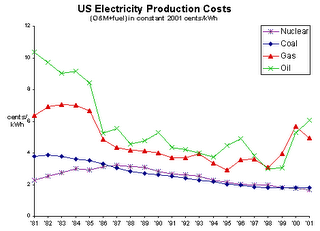
The U.S. looks about the same as coal to me, but if France does not have access to coal then it would be cheaper than any of the other sources.
So what are the economic benefits?
• Nuclear power is cost competitive with other forms of electricity generation, except where there is direct access to low-cost fossil fuels.
• Fuel costs for nuclear plants are a minor proportion of total generating costs, though capital costs are greater than those for coal-fired plants.
• In assessing the cost competitiveness of nuclear energy, decommissioning and waste disposal costs are taken into account.
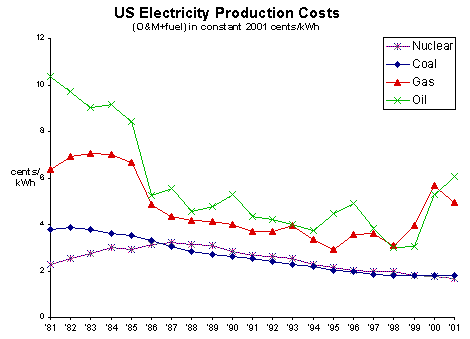
The U.S. looks about the same as coal to me, but if France does not have access to coal then it would be cheaper than any of the other sources.
Market for used tires?
When I went to price out new tires, for my new truck, I came across an additional cost in the purchase that I had not accounted for. The cost was titled "environmental disposal fee" and said nothing more. I went to the company's website and found out that they have a link to an explaination of said fee. The explaination is as follows:
"Environmental fees are state-mandated charges applied when you purchase new tires.
In many states, the funds raised by the collection of environmental fees go towards research and development on recycling worn out tires as an option to placing them in landfills. You may not know this, but materials reclaimed from old tires are used to power electrical plants, stop erosion in watersheds, assist in the drainage of golf courses and greenbelts, and can even be used in the construction of new homes."
To which I said inefficient!! If the market can find a value for the disposal services of tires, why then would the state mandate a fee associated with disposal. Why aren't they paying me for disposal of tires, if after all they are valuable. Its this type of policy that makes me wish politicians should be required to have a degree in econmics.
"Environmental fees are state-mandated charges applied when you purchase new tires.
In many states, the funds raised by the collection of environmental fees go towards research and development on recycling worn out tires as an option to placing them in landfills. You may not know this, but materials reclaimed from old tires are used to power electrical plants, stop erosion in watersheds, assist in the drainage of golf courses and greenbelts, and can even be used in the construction of new homes."
To which I said inefficient!! If the market can find a value for the disposal services of tires, why then would the state mandate a fee associated with disposal. Why aren't they paying me for disposal of tires, if after all they are valuable. Its this type of policy that makes me wish politicians should be required to have a degree in econmics.
Price Of Gas Is High!!
Who do you think makes the most money on the sale of a gallon of gas? I'll tell you. It’s not “Big Oil.” It’s Big Government. Gas taxes are worth 5 to 10 times what gas profits are. The federal and state governments use the tax money to build roads, while the oil and gas companies reinvest their profits into equipment and infrastructure.
Gas prices are higher now. That can be blamed on three groups of people.
1. The environmental lobby: They are primarily responsible for the fact that a refinery hasn't been built in
2. The federal government: For listening to the environmentalists and not acting faster to promote alternative fuels.
3.
Congress is calling for price-gouging investigations and a windfall profits tax. If price-gouging had occurred, we’d already know about it. And a tax on excess profits is simply a bad idea and sends a terrible message to other industries. Plus, the money would be wasted by the government.
Sunday, April 30, 2006
negative externality of CAFE standard and stupid people
the recent elimination of exemption of autos over specific gvw is expected to raise economy and help fuel consumption but . if those seeking tax breaks and those seeking new truck sales behave in a rational manner the higher standard will just proove the fact that raising the bar generates stilt sales for taller stilts!! acording to this guys rant http://www.tpmcafe.com/node/28972 the car maker has made decisions to keep ahead of CAFE standards over the years that have produced porky trucks that do less than their predecessors. as a car Buff i see many flaws in the argument . but it is entirely possible that car makers have avoided innovation and increases in mileage over the years just to reduce costs. but he argues that they have been avoiding the standard. and that this revision of the standard will be a major improvment to helping fuel economy . what if ?, to get around the standard again the car makers just keep making the trucks heavy ? if all it takes is more weight then there is no reason they wont just bolt plates of lead into the floor and move on . to think that a change was needed and would be effective with out looking at his own argument that car makers have made decisions to keep advances out of trucks and purposly build heavy usless trucks is absurd. how about if it werent for CAFE standards the truck companys may have never made an extended cab truck , if not for the exmptions for taxes and write off potential to buisness, the small buisness owners wouldent buy trucks instead of cars.. i know of someone who hasent driven 1000 miles on his 2005 ford 1 ton truck and has no use for a truck yet because it qualifys for a specific credit or refund he bought a truck instead of a car. if there were no incentive there would have been a rational decision . many of these things may come about if CAFE hadent been implemented. so this authors argument that evil automakers arent using advances to make their product superior is quite flawed. and his comparason to a mercedes delivery truck is also laughable . instead of touting the mercedes advanced abilitys and more usefull attributes he should have been looking at the market forces that created such trucks . the real problem (if his supposition that the us truck makers had acted in the manner that he described) is how much better the domestic trucks would have been if CAFE standards hadent influenced the makers decisions . so if he is correct then he is also full of sandwich meat!!! and to counter his argument . in the medium duty truck market (which was minimaly regulated by mechanisims like CAFE) there were produced and still are produced 1.5 to 2 ton trucks that equall or surpass the capibilitys of the sprinter . they weigh more haul more and get darn near the same mileage with 20+ yr old tech. the delivery market and consumer market are vastly different and he has compared a delivery van with a farm truck.... the reason 20 + years ago there were allmost 2 ton trucks getting 20 mpg was its market was not interfered with! and buisness owners were looking for any way to deliver the goods with lowest costs and truck makers were looking to sell trucks! so if one were to compare apples to apples the real reason pickup trucks are gas hawgs is actually CAFE standards.
Global Warning
Although uncertainties lie in the realm of global warming, and despite the notion that warm spells have occurred many times throughout the life of our planet, increasing temperatures pose a problem whose most harm will be felt by future generations. By now everyone is aware of the predicament; production (be it microwaves or assembly lines) begets greenhouse gases such as carbon dioxide, which in turn prevents heat from radiating off the earth’s surface and back into the atmosphere. That much we do know.
But the connection of human activity and warmer climates is not being bought by the public; many find it hard to concern themselves with a threat that may be hundreds of years away from showing any bite. Recent surveys posted in the New York Times show the environment as being far down on the list of national worries behind the economy, terrorism, health care, poverty, education, and President Bush. There is a major difference, however, between the warming experienced in earlier times than that of today; higher effected population. If ice sheets in Antarctica and Greenland rise the several feet by 2100 as some experts are predicting, shorelines will be flooded. Approximately 80 percent of the world’s population lives “on the coast” and rising waters could turn disastrous. Federal insurance and government subsidies might no longer be a good idea for encouraging coastal development.
Whether or not the wellbeing of future generations is the responsibility of today or not is an individual decision, but policy needs to be considerate of problems we are all aware of. Perhaps a recent strong push for more efficient forms of energy will be the saving grace needed to prevent drastic damage to the environment and its people. Locally, UCCS is trying to do its part by implementing a new recycling program and striving for energy efficiency by adhering to the LEED policy that promotes more environment friendly practices during construction of the new science and engineering building.
But the connection of human activity and warmer climates is not being bought by the public; many find it hard to concern themselves with a threat that may be hundreds of years away from showing any bite. Recent surveys posted in the New York Times show the environment as being far down on the list of national worries behind the economy, terrorism, health care, poverty, education, and President Bush. There is a major difference, however, between the warming experienced in earlier times than that of today; higher effected population. If ice sheets in Antarctica and Greenland rise the several feet by 2100 as some experts are predicting, shorelines will be flooded. Approximately 80 percent of the world’s population lives “on the coast” and rising waters could turn disastrous. Federal insurance and government subsidies might no longer be a good idea for encouraging coastal development.
Whether or not the wellbeing of future generations is the responsibility of today or not is an individual decision, but policy needs to be considerate of problems we are all aware of. Perhaps a recent strong push for more efficient forms of energy will be the saving grace needed to prevent drastic damage to the environment and its people. Locally, UCCS is trying to do its part by implementing a new recycling program and striving for energy efficiency by adhering to the LEED policy that promotes more environment friendly practices during construction of the new science and engineering building.
Saturday, April 29, 2006
Holy Freakin' Cow - look at these proposals
I was writing my Urban Econ term paper (I'm going to cross-post this on the other blog btw) and I came across this. These proposals have an amazing belief that we can achieve some sort of immediate utopia. Scroll down under the title "Solutions that are feasible, healthy, and sustainable" and you'll find such "feasible" solutions as "The immediate installation of full-roof solar panels on every building in America" and "An immediate tripling of minimum vehicle miles per gallon standards for all vehicles produced in America - accomplished by a quick and complete conversion of all factories to the building of only hybrid, solar, and fully electric vehicles." I like to dream too. I had to look up moratorium - it means "to put an end to" or "suspension."
Friday, April 28, 2006
Tax incentive
I found a link that allows you to pick any state and find put what the state offers for tax incentives for buying a hybrid or electric vehicle.
If you look under the state of colorado it shows the amounts avialable for certain cars, which there are about only 6. One offers $4,718 for one year if u purchased a specific Toyota vehicle. There was not one tax credit amount under $1000 even on that list. Thats just unbelievable that we are getting taxed for other people buying cars and then giving them MORE money back. I find that just completely stupid and redundant.
In the state of Wisconsin allows the city to deduct almost the full cost of the vehicle.
"The full deduction is $50,000 for any truck or van with a gross vehicle weight rating (GVWR) of at least 26,000 pounds (lbs.) or a bus with seating capacity of at least 20 adults. The deduction is $5,000 for a truck or van with a GVWR greater than 10,000 lbs. and $2,000 for vehicles under 10,000 lbs."
However, they did starts a clean fuel school bus program, with some of those vehicles. The school runs the busses on biodeisel and files for reimbursement of the funds from the state. The state will incure the entire cost of the fuel being used, even when the biodiesel prices are higher than just petroleum diesel fuel.
So of the uses being provided state wise seems to be more rational that just simple tax credits to buyers of new vehicles. I like how the State of Wisconsin uses state money to fund a clean fuel bus line for the schools. The taxes are applied on the school program, as cost incure. The money is highly reguladed by the state and set aside for the program. If costs are lower than the tax credit amount the tax is allocated back to the people in a form of a utility credit.
Also one of the State Statues requires that "A state excise tax, based on the standard number of British thermal units per gallon generated by each alternative fuel, is imposed on the use of alternative fuels. No tax is imposed on alternative fuels used by vehicles for urban mass transportation of passengers." The state does not tax the excise tax on busses, but on personal vehicles. They are more efficient oh the use of the tax and the money the apply from those taxes.
I simply think that tax breaks on buying a more efficient car is the most efficient way or even a market ability that is necessary.
If you look under the state of colorado it shows the amounts avialable for certain cars, which there are about only 6. One offers $4,718 for one year if u purchased a specific Toyota vehicle. There was not one tax credit amount under $1000 even on that list. Thats just unbelievable that we are getting taxed for other people buying cars and then giving them MORE money back. I find that just completely stupid and redundant.
In the state of Wisconsin allows the city to deduct almost the full cost of the vehicle.
"The full deduction is $50,000 for any truck or van with a gross vehicle weight rating (GVWR) of at least 26,000 pounds (lbs.) or a bus with seating capacity of at least 20 adults. The deduction is $5,000 for a truck or van with a GVWR greater than 10,000 lbs. and $2,000 for vehicles under 10,000 lbs."
However, they did starts a clean fuel school bus program, with some of those vehicles. The school runs the busses on biodeisel and files for reimbursement of the funds from the state. The state will incure the entire cost of the fuel being used, even when the biodiesel prices are higher than just petroleum diesel fuel.
So of the uses being provided state wise seems to be more rational that just simple tax credits to buyers of new vehicles. I like how the State of Wisconsin uses state money to fund a clean fuel bus line for the schools. The taxes are applied on the school program, as cost incure. The money is highly reguladed by the state and set aside for the program. If costs are lower than the tax credit amount the tax is allocated back to the people in a form of a utility credit.
Also one of the State Statues requires that "A state excise tax, based on the standard number of British thermal units per gallon generated by each alternative fuel, is imposed on the use of alternative fuels. No tax is imposed on alternative fuels used by vehicles for urban mass transportation of passengers." The state does not tax the excise tax on busses, but on personal vehicles. They are more efficient oh the use of the tax and the money the apply from those taxes.
I simply think that tax breaks on buying a more efficient car is the most efficient way or even a market ability that is necessary.
Thursday, April 27, 2006
Rising Gas Prices---I call it price gouging
My first question I ask myself when I hear that gas prices are rising is How can prices climb so much, seemingly overnight, when the gasoline in the tank beneath the station was bought by the retailer a day or two before and was probably refined from crude oil weeks or even months ago?
I would classify the rising prices gouging where particular states have passed laws against "price gouging," their different definitions reveal how slippery and arbitrary the concept is. What all this boils down to is that prices higher than what observers are used to are called "gouging." In other words, prices under normal conditions are supposed to prevail under abnormal conditions. This completely misunderstands the role of prices. Why do prices exist at all? To cause things to be produced and made available to the public -- and to cause consumers to limit how much they consume. Why then do prices suddenly shoot up? Because there is either less of a supply available or more of a demand, or both. What do higher prices do? Force people to restrain their own purchases more so than usual. What do higher profits do? Cause more money to be invested in producing whatever is earning higher profits, and this in turn expands output. Isn't a larger supply of oil and a reduced consumption of it what we want? Thats the question Im still pondering when all this gas discussions arise.......
I would classify the rising prices gouging where particular states have passed laws against "price gouging," their different definitions reveal how slippery and arbitrary the concept is. What all this boils down to is that prices higher than what observers are used to are called "gouging." In other words, prices under normal conditions are supposed to prevail under abnormal conditions. This completely misunderstands the role of prices. Why do prices exist at all? To cause things to be produced and made available to the public -- and to cause consumers to limit how much they consume. Why then do prices suddenly shoot up? Because there is either less of a supply available or more of a demand, or both. What do higher prices do? Force people to restrain their own purchases more so than usual. What do higher profits do? Cause more money to be invested in producing whatever is earning higher profits, and this in turn expands output. Isn't a larger supply of oil and a reduced consumption of it what we want? Thats the question Im still pondering when all this gas discussions arise.......
Wednesday, April 26, 2006
Ethanol production will save us all from the evil of oil!!!!!!
Please keep this in mind when talking about using food to power cars. "20 % of all fossil fuel in USA is used in relation to food production in this country !!!!!!!!!!!!!!!!!!!!!!!!!!!!!!!!!!!!!!!!!!!!! I was listening in class to ethanol discussion and later on in the week, I heard an interview with an author. He was writing about healthy eating, yet he ended up going over very economic stuff as well as political stuff. I guess it’s just that pervasive, politics and money, are involved with everything in life. He begins with discussion about the I industrialization of the food supply. And all the evils of bad diet etc… but about half way through the interview ethanol comes up.
Any way here is the author and his book
Michael Pollan, author of The Omnivore's Dilemma: A Natural History of Four Meals; Knight professor of journalism, University of California, Berkeley
Ethanol production is described here in detail
http://www.eia.doe.gov/oiaf/analysispaper/biomass.html
If you have 10 minutes I recommend you listen to this clip fast forward to the ethanol discussion if you want to save time.
http://download.npr.org/anon.npr-www/chrome/icon_listen.gifchain
After 6.30 (6 min 30 seconds)…listen in to the discussion till about 17 minutes.
So it takes 1/3 gal of oil to produce enough corn to make about 1\3 gallon of ethanol which has less energy content than gasoline per gallon… If the president wants to use corn ethanol to solve oil problems then he is misinformed as a leader I wish his advisors were smarter! And had him qualify his statement with non-corn based. Basically to solve an oil crisis it is not a great idea to use corn…Why? You ask…. Well for one thing Corn is an oil product!!!!!!! Ethanol production should be from low cost items like saw grass etc.. Corn just takes tons of energy to make. So our investment will not pay dividends.
At 19:29-he talks about corn based economy problems.
The subsidy system has caused the perceived problem so we have problems with allocation of tax dollars causing another problem that we are considering subsidizing as well.
Reminds me of some quote about good after bad… think it involved money. The government is just so huge it cant see the left hand and the right at the same time so it ends up paying out to cause a problem and then paying to solve same problem. It’s the same fundamental problem that communism had there are so many choices to make in an economy that those decisions should be made by the market to be efficient. Communism thought a central control could make all the right decisions and I keep seeing when there is a failure of the market it usually involves taking power from the market to decide.
I also found this
View Ethanol Today magazine's "Technical Connections" series on the steps of the ethanol production process.
http://www.sciencedaily.com/releases/2005/03/050329132436.htm
Study: Ethanol Production Consumes Six Units Of Energy To Produce Just One
In 2004, approximately 3.57 billion gallons of ethanol were used as a gas additive in the United States, according to the Renewable Fuels Association (RFA). During the February State of the Union address, President George Bush urged Congress to pass an energy bill that would pump up the amount to 5 billion gallons by 2012. UC Berkeley geoengineering professor Tad W. Patzek thinks that's a very bad idea.
"I've come to the conclusion that if we're smart about it, nuclear power plants may be the lesser of the evils when we compare them with coal-fired plants and their impact on global warming," he says. "We're going to pay now or later. The question is what's the smallest price we'll have to pay?"
Some other tidbits from the interview that were interesting.
28:34 talks about sustainability of food production.
80 % of Iowa food is imported…
56 calories to move 1 calorie of food to cross country “real efficient” eh.
We subsidies corn syrup and tariff sugar cane. Thus preventing cane sugars domestic price from being competitive
Ethanol infrastructure Not there to distribute it and since energy content also not there we will need to consume more to receive same marginal benefit.
Corn costs oil to produce. Its energy is from oil not necessarily the sun…and its use is pervasive. Corn syrup. Beef, chicken, lots of products are corn based. It’s one crop, which we use extensively.
A large percentage of all our stuff is from corn… including us… chemical fertilizer I bushel of corn takes 1\3 gallon of oil we produce 20 billion bushels a year!!!!!!!!!
Corn is subsidized, then we get Ethanol from corn, so if they subsidise ethanol? its duble down time on the tax dollars Is a break-even process… maybe 90% waste?
So at best we get 10% return. On our oil input. What a deal sign me up.
Tuesday, April 25, 2006
Gas price policies
A couple of weeks ago, Ben Lieberman over at the Heritage Foundation analysed some proposed suggestions to the increase in gasoline prices. Lieberman did his analysis from a framework of what is cheaper for consumers, so I decided to see analyse his analysis from an efficiency perspective.
Point one - expand energy production at home
When economists talk about expanding production at home, we are talking about subsidizing an industry. This would be bad from an economic perspective since there are no positive externalities associated with energy production. However, Lieberman is not talking about government doing more to lower prices, as subsidies would do, but he is instead talking about it doing less. He points out that when prices were cheap, government banned drilling in ANWR and offshore sites. Such a ban cannot satisfy efficiency. It ignores the fact that producers could get oil out of the ground for cheaper than the market price; if they couldn't, such a ban would be pointless. Since there is no efficiency reason for government to be involved, externality, monopoly, or public good, then it would be more efficient for government to do less.
Point two - deregulate
Lieberman's second point is that deregulating the production of gas from oil would lower the price of gasoline. These regulations are command-and-control regulations that serve no efficiency purposes. They are attempts at protecting the environment, but if there were reasons to do so that the market was failing to account for, and again this would require a monopoly, externality, or public good to exist, then measures could and should be taken to fix the market failure and make things more efficient. However, the argument for market failure usually centers around the possibility of externalities (aesthetics, health, etc.), so the only government intervention that might be more efficient would be subsidies and taxes, not regulations. Lieberman's proposal of deregulation would not only lower gas prices, but would also be more efficient.
Point three - don't raise taxes
Lieberman also pointed out that a couple of politicians proposals that would increase the price of gasoline. The first is to raise taxes. Tax increases have been proposed for various reasons, including to reduce consumption of gasoline or purely because they don't like how much money oil companies are making. While Lieberman is right that it would increase gas prices, a tax on gasoline may be legitimate if negative externalities exist for the use of gasoline, such as pollution (and current taxes don't already fix those externalities). However, raising taxes simply because a company has profits is rediculous. There is no externality for profits, and the motives are pure envy, not efficiency.
Point four - no additional regulations
Lieberman also suggested consumers would be hurt by more regulations. The regulations being considered include forcing automakers to make more fuel-efficient cars. Fuel-efficiency is not a public good and no one has a monopoly on fuel-efficiency or anything related to it, so these regulations must be inefficient. Even if their was a market-failure, it would be an externality, so forcing politicians' will on automakers would not achieve efficiency.
Lieberman wasn't directly using efficiency as a framework for analysing these policies, but his framework is similar, and I wonder if he had efficiency in the back of his mind. He may have been thinking of the efficiency framework, but using the "consumer" framework so that everyone could relate better. Either way, the conclusions of the two frameworks are quite similar if not the same.
Point one - expand energy production at home
When economists talk about expanding production at home, we are talking about subsidizing an industry. This would be bad from an economic perspective since there are no positive externalities associated with energy production. However, Lieberman is not talking about government doing more to lower prices, as subsidies would do, but he is instead talking about it doing less. He points out that when prices were cheap, government banned drilling in ANWR and offshore sites. Such a ban cannot satisfy efficiency. It ignores the fact that producers could get oil out of the ground for cheaper than the market price; if they couldn't, such a ban would be pointless. Since there is no efficiency reason for government to be involved, externality, monopoly, or public good, then it would be more efficient for government to do less.
Point two - deregulate
Lieberman's second point is that deregulating the production of gas from oil would lower the price of gasoline. These regulations are command-and-control regulations that serve no efficiency purposes. They are attempts at protecting the environment, but if there were reasons to do so that the market was failing to account for, and again this would require a monopoly, externality, or public good to exist, then measures could and should be taken to fix the market failure and make things more efficient. However, the argument for market failure usually centers around the possibility of externalities (aesthetics, health, etc.), so the only government intervention that might be more efficient would be subsidies and taxes, not regulations. Lieberman's proposal of deregulation would not only lower gas prices, but would also be more efficient.
Point three - don't raise taxes
Lieberman also pointed out that a couple of politicians proposals that would increase the price of gasoline. The first is to raise taxes. Tax increases have been proposed for various reasons, including to reduce consumption of gasoline or purely because they don't like how much money oil companies are making. While Lieberman is right that it would increase gas prices, a tax on gasoline may be legitimate if negative externalities exist for the use of gasoline, such as pollution (and current taxes don't already fix those externalities). However, raising taxes simply because a company has profits is rediculous. There is no externality for profits, and the motives are pure envy, not efficiency.
Point four - no additional regulations
Lieberman also suggested consumers would be hurt by more regulations. The regulations being considered include forcing automakers to make more fuel-efficient cars. Fuel-efficiency is not a public good and no one has a monopoly on fuel-efficiency or anything related to it, so these regulations must be inefficient. Even if their was a market-failure, it would be an externality, so forcing politicians' will on automakers would not achieve efficiency.
Lieberman wasn't directly using efficiency as a framework for analysing these policies, but his framework is similar, and I wonder if he had efficiency in the back of his mind. He may have been thinking of the efficiency framework, but using the "consumer" framework so that everyone could relate better. Either way, the conclusions of the two frameworks are quite similar if not the same.
Friday, April 21, 2006
Global Termperature 1880 - 2000
You can check out a chart of global temperatures via NASA right here.
Monday, April 17, 2006
Saturday, April 15, 2006
States Taking The Lead on Alternative Energy Ideas
Since we recently discussed these topics in class, alternative energy and sources of economic efficiencies, I thought it was an appropriate blog.
This article was written by the managing editor of the Rocky Mountain Institute (RMI), Joel Swisher. RMI is "an entrepreneurial nonprofit organization that fosters the efficient and restorative use of resources to make the world secure, just, prosperous, and life-sustaining".
Swisher opens the article describing how DC keeps talking about alternative energy sources, but that states are ahead of the national government. He then debates as to whether or not these alternatives are economically efficient. He describes how some states are starting to use portfolio standards that require alternative energy sources to be used by utility companies within a certain period of time (5-15 years). Portfolio Standards are a "flexible, market-driven policy that can ensure that the public benefits of wind, solar, biomass, and geothermal energy continue to be recognized as electricity markets become more competitive. The policy ensures that a minimum amount of renewable energy is included in the portfolio of electricity resources serving a state or country, and -- by increasing the required amount over time -- can put the electricity industry on a path toward increasing sustainability. Because it is a market standard, pollution standard relies almost entirely on the private market for its implementation. Market implementation will result in competition, efficiency and innovation that will deliver renewable energy at the lowest possible cost." (Renewables Portfolio Standard)
Other alternative energy considerations Swisher outlined were for states to use "feebates". A feebate is a fee or a rebate that is assigned to each individual vehicle type based on a fuel economy benchmark set annually for each vehicle size class. Buyers of more efficient vehicles receive a rebate; buyers of less efficient vehicles pay a fee. This would shift the costs to the right people, not taxing everyone, but taxing the right people.
Swisher refers to a document that the RMI wrote in conjunction with the Pentagon entitled The Oil Endgame. In the document they consider how auto manufacturers should be developing lines of lighter, safer and more fuel efficient domestic vehicles to reduce our overseas oil consumption. Additionally, that we should look closer at hybrids and They believe that this change of technology will shift the supply and demand balance of oil. The issue they did not discuss was the costs of production using these new lighter materials, such as carbon composites, advanced steels. And, will the production costs outweigh the competitive price of other similar vehicles? Or, will they produce the lighter cars at the right time while gas prices are at an all time high and let the market dictate.
If anyone wishes to read the "The Oil Endgame", I have downloaded a copy that can be emailed.
This article was written by the managing editor of the Rocky Mountain Institute (RMI), Joel Swisher. RMI is "an entrepreneurial nonprofit organization that fosters the efficient and restorative use of resources to make the world secure, just, prosperous, and life-sustaining".
Swisher opens the article describing how DC keeps talking about alternative energy sources, but that states are ahead of the national government. He then debates as to whether or not these alternatives are economically efficient. He describes how some states are starting to use portfolio standards that require alternative energy sources to be used by utility companies within a certain period of time (5-15 years). Portfolio Standards are a "flexible, market-driven policy that can ensure that the public benefits of wind, solar, biomass, and geothermal energy continue to be recognized as electricity markets become more competitive. The policy ensures that a minimum amount of renewable energy is included in the portfolio of electricity resources serving a state or country, and -- by increasing the required amount over time -- can put the electricity industry on a path toward increasing sustainability. Because it is a market standard, pollution standard relies almost entirely on the private market for its implementation. Market implementation will result in competition, efficiency and innovation that will deliver renewable energy at the lowest possible cost." (Renewables Portfolio Standard)
Other alternative energy considerations Swisher outlined were for states to use "feebates". A feebate is a fee or a rebate that is assigned to each individual vehicle type based on a fuel economy benchmark set annually for each vehicle size class. Buyers of more efficient vehicles receive a rebate; buyers of less efficient vehicles pay a fee. This would shift the costs to the right people, not taxing everyone, but taxing the right people.
Swisher refers to a document that the RMI wrote in conjunction with the Pentagon entitled The Oil Endgame. In the document they consider how auto manufacturers should be developing lines of lighter, safer and more fuel efficient domestic vehicles to reduce our overseas oil consumption. Additionally, that we should look closer at hybrids and They believe that this change of technology will shift the supply and demand balance of oil. The issue they did not discuss was the costs of production using these new lighter materials, such as carbon composites, advanced steels. And, will the production costs outweigh the competitive price of other similar vehicles? Or, will they produce the lighter cars at the right time while gas prices are at an all time high and let the market dictate.
If anyone wishes to read the "The Oil Endgame", I have downloaded a copy that can be emailed.
Wednesday, April 05, 2006
A call to ation for clean air
Air pollution is taking its effect on those both healthy and sensitive people. Even with low levels of pollution there is still an adverse effect on people. With air being the most vital resource to all living species we need to find a better way to keep it cleaner. In the Atlatnta region the smog problem has reached one of the worst in the country. The last time that this region has passed the federal air quality standard was in 2004. This past year in 2005 the city had 17 red smog days. Over half of the population in Georgia is breathing unhealthy air. Georgia's childrenwith asthma recive 28 million dollars in health care a year and on some days are not allowed to be outside for an extended period of time due to the pollution. Everytime we turn on a light or start our car we are using energy which produces pollution. One way that we can try and reduce these problems is to try and drive less and keep lights turned off in rooms that are not being used. This may only help with some of the problems but we also need to use our technilogical advancements to reduce the big contributers to the pollution like smokestacks. Although air pollution is a big issue i do not think that the problem is by itself causing heart disease, asthma, and lung problems. These problems may be enhanced by the effects of air pollution but do they really cause the problem itself? We are approaching a dangerous abundance of the number of polluting gases which in turn is increasing global warming. These issues need to be resolved or we will see a decrese in life expectency.
Monday, April 03, 2006
Curbside Recycling
I recently read a commentary that most recycling programs are a waste. Among the points noted were: no shortage of landfill space (another thousand years of garbage would only fill an area 35 miles square by 100 yards deep), double energy consumption and pollution (just preparing the recyclables can use as much energy and create as much waste as using virgin material), and cost (most recycling programs lose money).
All that having been said, the fact that something can be recycled doesn't mean it should be. Forget the esoteric arguments about externalities, finite resources, and so on--in the end recycling will (or won't) work because it is (or isn't) cheaper than throwing stuff away. This varies with the material being recycled. As a general proposition, any manufactured product that is (a) heavy or expensive in relation to its bulk, (b) homogeneous, and (c) easily separable from the waste stream by consumers can be recycled economically. Metals, notably steel and aluminum, are the obvious examples; both have high recycling rates. Surprisingly, so does newsprint. The poor candidates, at the moment, are plastics and mixed paper (including magazines). Plastics are too light and heterogeneous, while mixed paper contains too many contaminants. In the end we may conclude that this junk is best consigned to landfills. But given the advance of technology, who knows? We're in the midst of a great national experiment, and we'd be foolish at this stage to prejudge the results.
All that having been said, the fact that something can be recycled doesn't mean it should be. Forget the esoteric arguments about externalities, finite resources, and so on--in the end recycling will (or won't) work because it is (or isn't) cheaper than throwing stuff away. This varies with the material being recycled. As a general proposition, any manufactured product that is (a) heavy or expensive in relation to its bulk, (b) homogeneous, and (c) easily separable from the waste stream by consumers can be recycled economically. Metals, notably steel and aluminum, are the obvious examples; both have high recycling rates. Surprisingly, so does newsprint. The poor candidates, at the moment, are plastics and mixed paper (including magazines). Plastics are too light and heterogeneous, while mixed paper contains too many contaminants. In the end we may conclude that this junk is best consigned to landfills. But given the advance of technology, who knows? We're in the midst of a great national experiment, and we'd be foolish at this stage to prejudge the results.
Why cellulosic ethanol is better than corn ethanol
In recent debates with energy policies, fuel has become and increasing problem for policy makers. The decisions to switch from gasoline to alternative fuels has lead officials to asses different alternatives, one being the use of ethnol. In the last decade the use of corn ethnol as an clean burning fuel has been thought of as the optimal source in creating environmental efficientcy by providing cleaner burning fuel. However, a new form of ethanol has come to emerge as the sole provider of cleaner burning fuel. Is this alternative a better solution?
In assessing whether or not biofuel saves more energy in the complete process of creating energy we must first take a look at the cultivation of the vvarious crops taht can be used to produce fuel. Fuel that uses the more traditional approtach by way of corn may yeild only marginal renewalbe envergy retruns, while ehtanol obtained from cellulose (a technology that uses fibours materials such as wood chips, or farm residues) has a clear advantage. The biggest reason cellulosic ehtano has a better energy balance than corn is that the whole plant can be used within the fuel proces. The fermentable compoonenet( is sperarated from the nonfermentable component(lignin) which yields a high energy value.
On the flip side, large scale ehtonol production rasies other envronmental concerns, the biggest being air quality. The low blends predominantly used today have higher evaporatiotvie emissions than regular gasoline in warmer climates which contributes to ozone problems. A solution to this problem could be to use ethanol in high blends.
Today ethanol is only used as a fuel additive to help it burn cleaner. The question now is how quickly can we make the transition to using ethanol as an alternative fuel as aopposed to jsut an additive?
In assessing whether or not biofuel saves more energy in the complete process of creating energy we must first take a look at the cultivation of the vvarious crops taht can be used to produce fuel. Fuel that uses the more traditional approtach by way of corn may yeild only marginal renewalbe envergy retruns, while ehtanol obtained from cellulose (a technology that uses fibours materials such as wood chips, or farm residues) has a clear advantage. The biggest reason cellulosic ehtano has a better energy balance than corn is that the whole plant can be used within the fuel proces. The fermentable compoonenet( is sperarated from the nonfermentable component(lignin) which yields a high energy value.
On the flip side, large scale ehtonol production rasies other envronmental concerns, the biggest being air quality. The low blends predominantly used today have higher evaporatiotvie emissions than regular gasoline in warmer climates which contributes to ozone problems. A solution to this problem could be to use ethanol in high blends.
Today ethanol is only used as a fuel additive to help it burn cleaner. The question now is how quickly can we make the transition to using ethanol as an alternative fuel as aopposed to jsut an additive?
Tax Incentives for Hybrids: Deductions and Credits
We are running out of oil, our main form of energy now. There are promising technologies and alternatives coming tomorrow.
There are numerous tax incentives and rebate programs for using less energy. The most immediate one is for those of us who purchased hybrid vehicles in 2005 (and earlier); depending on the vehicle, you can take a deduction of up to $2,000 off your income, even if you don’t itemize deductions. Depending on your tax bracket, this could reduce your tax bill by about 1/3 of this amount (around $660) this year.
Procrastinators rejoice, in 2006 the energy bill includes a tax credit for hybrids up to $3,600. A credit is subtracted from your total tax, not from your gross income, so it’s an actual dollar savings.
These incentives are interesting in several ways. The obvious is that we consumers have additional motivation to move towards energy efficient vehicles. But this works for the manufacturers too; any additional cost associated with making more efficient engines is offset, making them more attractive to buyers. And this is a pretty significant amount of money, after the credit the total cost will be reduced from $23,000 to around $20,000, or about 13% savings. People have been waiting to take delivery and the long wait for hybrids which has abated recently, is growing again.
Another interesting aspect is that the credit is indexed to the fuel economy of comparable non-hybrid vehicles. So let’s say you own a
Friday, March 31, 2006
End users paying environmental costs?? up front .
End users paying for end of life costs up front on products.. it seems inefficient in some ways but here is an example of it working .
Companies getting involved and not having government force their hand? How could this be?????
Non-profits taking a path to deal with waste.
Creating an organization to provide disposal service.
(http://www.rbrc.org/call2recycle/corporate/index.html )-about recycler
Then industry paying for and using the service with out any direct government intervention??
Weird….? Improbable.????
We just can’t get along without government guidance can we??
No its common sense.. if environmentalists want companies to reduce out put they can work out a deal . Demanding legislation is not always an efficient way to go about affecting change its like the person down river paying the polluter for each unit of pollution reduced. It gets to an optimal level..with no outside intervention….
Large companies like black and Decker etc.
( http://www.bdk.com/environment/faq.htm )
can afford to participate and are proud to do so they feel it will influence customer choice.
Small company’s who can’t swing it don’t pay in but the non-profit will still take their batteries because the bigger companies have footed the bill so there is a balance.
If government had stepped in and forced all producers into a command and control situation there would be small companies put out of market , government agencys to support to maintain and all the associated costs with government waste..
The current situation has come about with minimal government legislation and this is optimal I think… take a look
Links to related data :
http://www.bdk.com/environment/faq.htm link to policy
http://www.rbrc.org/call2recycle/ link to battery recycler…
http://www.rbrc.org/call2recycle/corporate/index.html about recycler
http://www.rbrc.org/call2recycle/docs/batteryalert.pdf EPA action
Companies getting involved and not having government force their hand? How could this be?????
Non-profits taking a path to deal with waste.
Creating an organization to provide disposal service.
(http://www.rbrc.org/call2recycle/corporate/index.html )-about recycler
Then industry paying for and using the service with out any direct government intervention??
Weird….? Improbable.????
We just can’t get along without government guidance can we??
No its common sense.. if environmentalists want companies to reduce out put they can work out a deal . Demanding legislation is not always an efficient way to go about affecting change its like the person down river paying the polluter for each unit of pollution reduced. It gets to an optimal level..with no outside intervention….
Large companies like black and Decker etc.
( http://www.bdk.com/environment/faq.htm )
can afford to participate and are proud to do so they feel it will influence customer choice.
Small company’s who can’t swing it don’t pay in but the non-profit will still take their batteries because the bigger companies have footed the bill so there is a balance.
If government had stepped in and forced all producers into a command and control situation there would be small companies put out of market , government agencys to support to maintain and all the associated costs with government waste..
The current situation has come about with minimal government legislation and this is optimal I think… take a look
Links to related data :
http://www.bdk.com/environment/faq.htm link to policy
http://www.rbrc.org/call2recycle/ link to battery recycler…
http://www.rbrc.org/call2recycle/corporate/index.html about recycler
http://www.rbrc.org/call2recycle/docs/batteryalert.pdf EPA action
Traditional American Indian Economic Policy
The title of this blog is of an essay I recently read by Ronald L. Trosper; while we aren't covering sustainability this semester, I still thought this might serve as a contrast and/or comparison to the value judgements that we are currently emphasizing.
The essay sets forth the assumption of the basic pan-Indian 'traditional' Indian viewpoint of respect. Trosper outlines four basic components of the definition of respect as being community and the economic aspect of reciprocity in exchange (human-to-human and human-to-nonhuman), which "provides a way to derive ethical statements about what policies should be selected, with a focus on today"; connectedness, which "furnishes a way to generate descriptions or models of the world in order to describe the consequences of policies"; seventh generation, which creates the time dimension and has direct implications for time valuation; and humility, which is "a statement about humanity's ability to understand the connections".
Trosper gives the following list of implications that this definition of respect has for development activities (and it should be noted that it is not implied that this is appropriate for non-Indian and non-reservation communities):
1. High grading is not allowed.
2. Consumption has an upper bound.
3. Ecosystem health should be maintained.
4. Nuclear and other hazardous waste should be avoided.
5. Although modern market niches such as gambling and reduced-tax sales can be used, savings from profits should be very high.
6. A community's population levels should remain within the carrying capacity of a community's resources.
It seems to me that understanding the ideology of this essay depends on the definitions of two terms: development and property rights. According to Trosper, 'development' in the modern sense of the word is not something that tribal communities aspire to, mainly because there is an emphasis on future consumption that requires much less consumption (but not necessarily production) today. If one equates development with increased levels of consumption of goods, then non-development would be preferable to the societies that emphasize future consumption. Conversely, these high savings rates and ability to supply the demands of the seventh generation would be seen more favorably by sustained-development proponents.
Property rights for these communities also holds a different meaning. Shunning private property, to them, does not mean rejecting the notion of property rights. Instead, the institution of usufruct tenure for individuals, combined with the institutions of generosity and tribal or band territorial division, is the preferred method of landholding. With usufruct tenure for individuals, use of the bounty of the land is granted, but the community maintains the right to cut off usage if the land and natural resources are being abused. The land in whole is passed on to the next generation. This is similar to the 'grazing' scenario in Yandle's book, but the difference here is that by consensus, the community may limit an abuser's right to use the land - and this may give rise to common law. While Trosper gives the example of the Navajo tribe as one that has suffered from a tragedy of the commons, he attributes this to the fact that the tribe has a world outlook of "ever increasing, never decreasing", or a rejection of scarcity, whereas most other tribes accept the idea of scarcity and thus have an incentive to marshal resources conservatively.
While reading this essay, I continued to wonder about the implications for a more dynamic society, one that incorporated and benefitted from technological advances. Toward the end, Trosper acknowledges that his future essays would consider how the four components of respect figure into technological change for reservation economies.
If anyone would like copies of this essay, I would be happy to oblige.
The essay sets forth the assumption of the basic pan-Indian 'traditional' Indian viewpoint of respect. Trosper outlines four basic components of the definition of respect as being community and the economic aspect of reciprocity in exchange (human-to-human and human-to-nonhuman), which "provides a way to derive ethical statements about what policies should be selected, with a focus on today"; connectedness, which "furnishes a way to generate descriptions or models of the world in order to describe the consequences of policies"; seventh generation, which creates the time dimension and has direct implications for time valuation; and humility, which is "a statement about humanity's ability to understand the connections".
Trosper gives the following list of implications that this definition of respect has for development activities (and it should be noted that it is not implied that this is appropriate for non-Indian and non-reservation communities):
1. High grading is not allowed.
2. Consumption has an upper bound.
3. Ecosystem health should be maintained.
4. Nuclear and other hazardous waste should be avoided.
5. Although modern market niches such as gambling and reduced-tax sales can be used, savings from profits should be very high.
6. A community's population levels should remain within the carrying capacity of a community's resources.
It seems to me that understanding the ideology of this essay depends on the definitions of two terms: development and property rights. According to Trosper, 'development' in the modern sense of the word is not something that tribal communities aspire to, mainly because there is an emphasis on future consumption that requires much less consumption (but not necessarily production) today. If one equates development with increased levels of consumption of goods, then non-development would be preferable to the societies that emphasize future consumption. Conversely, these high savings rates and ability to supply the demands of the seventh generation would be seen more favorably by sustained-development proponents.
Property rights for these communities also holds a different meaning. Shunning private property, to them, does not mean rejecting the notion of property rights. Instead, the institution of usufruct tenure for individuals, combined with the institutions of generosity and tribal or band territorial division, is the preferred method of landholding. With usufruct tenure for individuals, use of the bounty of the land is granted, but the community maintains the right to cut off usage if the land and natural resources are being abused. The land in whole is passed on to the next generation. This is similar to the 'grazing' scenario in Yandle's book, but the difference here is that by consensus, the community may limit an abuser's right to use the land - and this may give rise to common law. While Trosper gives the example of the Navajo tribe as one that has suffered from a tragedy of the commons, he attributes this to the fact that the tribe has a world outlook of "ever increasing, never decreasing", or a rejection of scarcity, whereas most other tribes accept the idea of scarcity and thus have an incentive to marshal resources conservatively.
While reading this essay, I continued to wonder about the implications for a more dynamic society, one that incorporated and benefitted from technological advances. Toward the end, Trosper acknowledges that his future essays would consider how the four components of respect figure into technological change for reservation economies.
If anyone would like copies of this essay, I would be happy to oblige.
Optimal allocation of cigarette smoke is 0?
I happen to disagree with the latest lawmaking happening in our states capitol building. I find it hard to believe that despite all of the education of our state legislators, not one of them had enough conviction to sway the rest of the vote in opposition of the latest smoking ban.
This latest law would suggest that the optimal allocation of second hand smoke is zero based on the understanding that the law prohibits smoking in all but a handful of locations. Coase would suggest otherwise, and I happen to agree with the model at hand. Governments role in the understanding of lawmaking has no right to completely abolish a smokers right to smoke. Make it more costly, tax it more, subsidize those who don't smoke, but DO NOT MAKE IT ILLEGAL!!
I happen to be a cigar smoker, not the everyday nic-fit cigarette smoker, so my rights to smoke at a cigar bar have been preserved, but it would seem that the rights of the smokers have been violated by governments attempt to control what they percieve as a bad.
It just seems frustrating to me that in all of the hooplah about this measure, not one politician was effective in portraying that this is not the role government.
This latest law would suggest that the optimal allocation of second hand smoke is zero based on the understanding that the law prohibits smoking in all but a handful of locations. Coase would suggest otherwise, and I happen to agree with the model at hand. Governments role in the understanding of lawmaking has no right to completely abolish a smokers right to smoke. Make it more costly, tax it more, subsidize those who don't smoke, but DO NOT MAKE IT ILLEGAL!!
I happen to be a cigar smoker, not the everyday nic-fit cigarette smoker, so my rights to smoke at a cigar bar have been preserved, but it would seem that the rights of the smokers have been violated by governments attempt to control what they percieve as a bad.
It just seems frustrating to me that in all of the hooplah about this measure, not one politician was effective in portraying that this is not the role government.
Water toxicity along the Mississippi
The Clean Water Act requires all water sanitation departments to meet minimum standards of water toxicity. This entails that all sanitation stations must make sure that a certain amount of chemicals and waste products are removed from water be it to be safe for swimming or drinking. The water sanitations systems, however, are not required to cleanse drinking water of harmful pesticides.
As water flows down the Mississippi river it accumulates more and more chemicals used in farming. None of these chemicals are tested for or required by law to come out of the water supply. The delta of the Mississippi, in New Orleans is highly toxic. It is filled with all the waste products of farming and none of the water is cleaned before it comes out of faucets in peoples homes.
As a result of this over site in legislation, water sanitation is at its lowest when it enters the Gulf of Mexico. While it is still considered drinkable, the water is full of chemicals that would otherwise be considered unsafe for human consumption. The city of New Orleans has one of the highest rates of intestinal cancers in the country.
This effects the economy of the area in that it effects the people of the area. Health insurance rates are considerably higher in this area due to the increased risk of cancers and worker productivity is cut down by illness. It is little wonder that businesses and people have been leaving this city since the late 1990's.
As water flows down the Mississippi river it accumulates more and more chemicals used in farming. None of these chemicals are tested for or required by law to come out of the water supply. The delta of the Mississippi, in New Orleans is highly toxic. It is filled with all the waste products of farming and none of the water is cleaned before it comes out of faucets in peoples homes.
As a result of this over site in legislation, water sanitation is at its lowest when it enters the Gulf of Mexico. While it is still considered drinkable, the water is full of chemicals that would otherwise be considered unsafe for human consumption. The city of New Orleans has one of the highest rates of intestinal cancers in the country.
This effects the economy of the area in that it effects the people of the area. Health insurance rates are considerably higher in this area due to the increased risk of cancers and worker productivity is cut down by illness. It is little wonder that businesses and people have been leaving this city since the late 1990's.
Global Warming and Energy Efficiency
Recently a report was released ranking world utility corporations based upon their ability to control, oversight, manage, disclose, and account for global warming and greenhouse emissions. San Diego based utility company Sempra was ranked second to last in the report, and BP was ranked as the first. Sempra believes the rankings from the commission were subjective.
The commission believed that because Sempra did not have an executive board to manage or address the environmental and economic issues of global warning, they did not attain the goal of being environmentally conscientious. Sempra responded with examples of their most recent improvements to the environment such as: the purchase of renewable energy sources that would assist in bringing more power to California and other homes; building state of the art natural gas fired plants; and building a liquified natural gas receiving terminal. Sempra believes these examples resemble those used to rank other such companies regarding global warming and greenhouse effects. The commission may be taking too narrow of a view of the costs some companies are taking to be environmentally friendly. Rather, by taking a more global view of the changes and improvements that are being accomplished and the effects on the earth, more companies may be seen in a different light.
The economic cost of maintaining and developing new energy resources is becoming increasingly larger. Most experts believe that the global warming and greenhouse effects will continue to worsen over time. Thus causing an economic disaster due to companies attempting to control and improve the environmental problems that may never get better. Additionally, most states are requiring the utility companies to use renewable energy sources to a certain percentage (as the article states, California has a 20% requirement by 2010). Companies are running out of time to find the renewable energy sources. It takes a number of years to locate an energy source, run tests, and determine that the sources would be cost efficient and effective. Do we have enough time, or because of the environmental damage already done, will it matter?
The commission believed that because Sempra did not have an executive board to manage or address the environmental and economic issues of global warning, they did not attain the goal of being environmentally conscientious. Sempra responded with examples of their most recent improvements to the environment such as: the purchase of renewable energy sources that would assist in bringing more power to California and other homes; building state of the art natural gas fired plants; and building a liquified natural gas receiving terminal. Sempra believes these examples resemble those used to rank other such companies regarding global warming and greenhouse effects. The commission may be taking too narrow of a view of the costs some companies are taking to be environmentally friendly. Rather, by taking a more global view of the changes and improvements that are being accomplished and the effects on the earth, more companies may be seen in a different light.
The economic cost of maintaining and developing new energy resources is becoming increasingly larger. Most experts believe that the global warming and greenhouse effects will continue to worsen over time. Thus causing an economic disaster due to companies attempting to control and improve the environmental problems that may never get better. Additionally, most states are requiring the utility companies to use renewable energy sources to a certain percentage (as the article states, California has a 20% requirement by 2010). Companies are running out of time to find the renewable energy sources. It takes a number of years to locate an energy source, run tests, and determine that the sources would be cost efficient and effective. Do we have enough time, or because of the environmental damage already done, will it matter?
San Joaquin Valley Battles Air Pollution
For several years now it has been known that California has struggled constantly to try and meet the air quality standards set forth by the Environmental Protection Agency. It is estimated that currently the air pollution in the San Joaquin Valley area, which encompasses San Joaquin, Merced, Fresno, Kings, Madera, Stanislaus, Tulare, and part of Kern county, is costing residents $1,000 each in health care annually. When you combine this cost along with the price of providing subsidies to the owners and operators of heavy-duty motor vehicles, locomotives, marine vessels, and stationary agricultural pumps, the costs of what it’s going to take to clean up the air pollution becomes a little more apparent. This, the monetary amount, is no little amount. If one were then to add the affects of the daily health problems the community deals with from this air pollution the number would be even higher.
Subsidies to heavy-duty machine operators in the community are being provided by the San Joaquin Valley Air Pollution Control District (SJVAPCD). They provide the community with the opportunity to make a contract with them stating that if they are willing to upgrade their equipment so that they pollute less, with the new or upgraded equipment, that they will receive a subsidy for their part in helping clean up the air. Many concerns from that of the expected population growth to the fact that individuals or businesses that were looking to upgrade anyhow may get a break from the government presents some very serious issues. One then might ask, are the subsidies the most effective way to meet the lower level of air pollution in the area? What’s going to happen to health care costs as the population grows? Is there another way to better address the pollution problem in the area? Are the standards set forth for the area even reasonable? At what price are the citizens willing to pay in order to breath cleaner air?
The answers to these questions will not come easily. As can be expected, all other things held constant, if the population increases, one can be assured that the amount of air pollution will rise, therefore increasing the costs of health related issues with dirty air. This author would not suggest that economically subsides would be the best route to reach the desired level of pollution. What might be a bit more effective would be a tax on the fuel that these vehicles use. However, with the understanding that political pressure often overpowers what might be right for the area economically, it is a little easier to see why the government may have chosen this route. As to whether or not the standards are reasonable is still an ongoing debate. Without further investigation on the topic it’s hard to say. What this author knows for sure is that the San Joaquin Valley faces some serious problems with air pollution and it will be interesting to see if the policies they are currently using to battle pollution will continue to be used in the future.
Subsidies to heavy-duty machine operators in the community are being provided by the San Joaquin Valley Air Pollution Control District (SJVAPCD). They provide the community with the opportunity to make a contract with them stating that if they are willing to upgrade their equipment so that they pollute less, with the new or upgraded equipment, that they will receive a subsidy for their part in helping clean up the air. Many concerns from that of the expected population growth to the fact that individuals or businesses that were looking to upgrade anyhow may get a break from the government presents some very serious issues. One then might ask, are the subsidies the most effective way to meet the lower level of air pollution in the area? What’s going to happen to health care costs as the population grows? Is there another way to better address the pollution problem in the area? Are the standards set forth for the area even reasonable? At what price are the citizens willing to pay in order to breath cleaner air?
The answers to these questions will not come easily. As can be expected, all other things held constant, if the population increases, one can be assured that the amount of air pollution will rise, therefore increasing the costs of health related issues with dirty air. This author would not suggest that economically subsides would be the best route to reach the desired level of pollution. What might be a bit more effective would be a tax on the fuel that these vehicles use. However, with the understanding that political pressure often overpowers what might be right for the area economically, it is a little easier to see why the government may have chosen this route. As to whether or not the standards are reasonable is still an ongoing debate. Without further investigation on the topic it’s hard to say. What this author knows for sure is that the San Joaquin Valley faces some serious problems with air pollution and it will be interesting to see if the policies they are currently using to battle pollution will continue to be used in the future.
The "Fix": Alternative Energy Resources
In his State of the Union address, President Bush expressed the United States’ dependency on oil as an “addiction,” a brave assessment that the administration and advocates for alternative energy sources hope will stimulate change. An enduring need for oil has put the United States in risky relations with oil-rich countries such as Iran, Venezuela, and Iraq and the threat of embargo has become an influential weapon of choice. Economic sanctions are refuted by these nations by threatening to cut off oil exports to selected importers. Ukrainians have already seen these effects, after facing mid-winter natural gas supply shortages imposed by Russians wanting a four-fold increase in price.
There are other reasons for alternative fuels as well. Poorer countries, such as Nepal and the Democratic Republic of Congo could experience dramatic decreases in GDP if the price of oil continues to increase. Ethiopia, a country overcome by AIDS would see almost all of $134 million aid erased by a $10 increase for a barrel of oil.
It’s no surprise to anyone that petrol-based fuels account for pollution. Tremendous environmental impacts have power plants, vehicles, and tanker spills, among others, to blame. Global warming has been widely speculated upon, and most people can agree that temperatures are getting warmer as population and consumption increase. Carbon dioxide, a prominent greenhouse gas released when burning fuels, is an inefficient and unclean bio-hazard whose harm can be reduced with the development of cleaner fuels such as ethanol or E-85.
Along with conducting business with these countries comes the worry that Americans who consume gas bought from countries in the Middle East are putting money into the hands of dangerous regimes and terrorist groups. Wealth gained from transaction of oil is attributed to only a few, and often, at the hands of citizens with little voice for the use of their countries natural resources. Dictators and regime-leaders rake in the reward for exporting oil, while the countrymen and women suffer from drought, famine, and disease without aid.
Of course, another of the leading reasons for finding alternate fuel sources is the diminishing supply of our non-renewable resources. Explosive economic and population growth in countries such as China, India, and Brazil is accounting for unprecedented competition for oil and natural gas. In 2005, Americans paid 17 percent more for energy than in the previous year, accounting for 40 percent of the rise in the consumer price index. The International Energy Agency is calling for $17 trillion in investment. But even if investment is made and more reserves are found, diminishing supply is inevitable. Competition for the last of the world’s reserves will greatly increase hostility and perhaps stall trade between countries with most to lose-and gain.
With so much dependency on the Middle East and other oil-rich hotspots, the United States and much of the rest of the world is coming face to face with economic and natural disaster. And because the United States relies so heavily on energy on a day to day basis, it is time for us to take the lead on alternative energy resources. The U.S. has the opportunity to take the lead on a global problem whose solutions could drastically change the livelihood of many, reduce greenhouse gases and the threat of global warming, and prevent a world war economic disaster on the premise of diminishing oil reserves.
There are other reasons for alternative fuels as well. Poorer countries, such as Nepal and the Democratic Republic of Congo could experience dramatic decreases in GDP if the price of oil continues to increase. Ethiopia, a country overcome by AIDS would see almost all of $134 million aid erased by a $10 increase for a barrel of oil.
It’s no surprise to anyone that petrol-based fuels account for pollution. Tremendous environmental impacts have power plants, vehicles, and tanker spills, among others, to blame. Global warming has been widely speculated upon, and most people can agree that temperatures are getting warmer as population and consumption increase. Carbon dioxide, a prominent greenhouse gas released when burning fuels, is an inefficient and unclean bio-hazard whose harm can be reduced with the development of cleaner fuels such as ethanol or E-85.
Along with conducting business with these countries comes the worry that Americans who consume gas bought from countries in the Middle East are putting money into the hands of dangerous regimes and terrorist groups. Wealth gained from transaction of oil is attributed to only a few, and often, at the hands of citizens with little voice for the use of their countries natural resources. Dictators and regime-leaders rake in the reward for exporting oil, while the countrymen and women suffer from drought, famine, and disease without aid.
Of course, another of the leading reasons for finding alternate fuel sources is the diminishing supply of our non-renewable resources. Explosive economic and population growth in countries such as China, India, and Brazil is accounting for unprecedented competition for oil and natural gas. In 2005, Americans paid 17 percent more for energy than in the previous year, accounting for 40 percent of the rise in the consumer price index. The International Energy Agency is calling for $17 trillion in investment. But even if investment is made and more reserves are found, diminishing supply is inevitable. Competition for the last of the world’s reserves will greatly increase hostility and perhaps stall trade between countries with most to lose-and gain.
With so much dependency on the Middle East and other oil-rich hotspots, the United States and much of the rest of the world is coming face to face with economic and natural disaster. And because the United States relies so heavily on energy on a day to day basis, it is time for us to take the lead on alternative energy resources. The U.S. has the opportunity to take the lead on a global problem whose solutions could drastically change the livelihood of many, reduce greenhouse gases and the threat of global warming, and prevent a world war economic disaster on the premise of diminishing oil reserves.
Thursday, March 30, 2006
Rational choice
The separation of economic efficiency and liberty is both perplexing and multifarious. Can values be accurately measured in economic terms? Are the measurements meaningful to the environment? One theory might have an answer. Rational choice theory is defined as, “a way of looking at deliberations between a number of potential courses of action, in which ‘rationality’ of one form or another is used either to decide which course of action would be the best to take, or to predict which course of action actually will be taken. Such a perspective finds itself in models for both human and behavior of non-human but nonetheless potentially rational entities, such as corporations or nation-states.”
What is considered to be rational?
The technical meaning in economics is about preferences: preferences are defined to be rational if they are complete and transitive. That is, that the decision-maker is able to compare all of the alternatives, and that these comparisons are consistent.
• If uncertainty is involved, then the independence axiom is often assumed in addition to rational preferences.
• If decision-making over time is involved, time consistency is generally assumed as well.
• Rationality can also mean that the decision-maker always chooses the most preferred option, as in the Utility Maximization problem.
Rational choice theory may help economists to better understand how an individual thinks regarding tastes and preferences. However, as we all know, not all are considered to be rational thinkers. Among the many policies, perhaps the amalgamation of liberty and economic efficiency may be the “solution matrimony” to a sustainable environmental policy.
What is considered to be rational?
The technical meaning in economics is about preferences: preferences are defined to be rational if they are complete and transitive. That is, that the decision-maker is able to compare all of the alternatives, and that these comparisons are consistent.
• If uncertainty is involved, then the independence axiom is often assumed in addition to rational preferences.
• If decision-making over time is involved, time consistency is generally assumed as well.
• Rationality can also mean that the decision-maker always chooses the most preferred option, as in the Utility Maximization problem.
Rational choice theory may help economists to better understand how an individual thinks regarding tastes and preferences. However, as we all know, not all are considered to be rational thinkers. Among the many policies, perhaps the amalgamation of liberty and economic efficiency may be the “solution matrimony” to a sustainable environmental policy.
Wind Power
Last year the U.S. led the world in wind production. While it did so with tax credits for wind generation, it did not require the use of the Kyoto Treaty. The rest of the world that signed the treaty has been upset at us for not signing it, yet here we are advancing non-"greenhouse gas" emitting generators faster than the rest of the world. This doesn't mean we are going to meet the Kyoto provisions (even most nations who signed on won't meet them), but it does show that all we need is a subsidy for cleaner generators to be produced more.
The U.S. has subsidized wind production for a while now, and is giving tax credits for wind generation for the next three years. The subsidies come beause wind produces virtually no air pollution, unlike the more common coal power plants. The subsidies give wind power an extra boost in sales. Already wind was becoming more comparable to coal in terms of price per kWh. Also, wind has been boosted by natural market forces, such as drought in Colorado, allowing power companies to rent or lease land for wind generation from farmers at cheaper prices. Other market forces exist as well. Most important of these are local communities' willingness to pay more for wind generation to avoid the pollution of coal.
That doesn't mean wind is beating coal in competition though. Given the vast abundance of coal in the U.S., keeping transportation costs for coal down, power companies are working to make coal much more efficient, at least according to the article. This will mean a reduction in emmissions of all kinds from the most polluting source.
Apparently, treaties and regulations aren't needed to reduce pollution. People naturally want to reduce pollution as their incomes rise. They are willing to pay more for clean air. The market, in this case made up of local communities, can thus result in lower pollution. While the Kyoto Treaty is much more market friendly than any CAC (command and control) alternative, time will tell if it was ever needed, or if it might even hinder clean electric development due to it's ability to hinder economic grow.
The U.S. has subsidized wind production for a while now, and is giving tax credits for wind generation for the next three years. The subsidies come beause wind produces virtually no air pollution, unlike the more common coal power plants. The subsidies give wind power an extra boost in sales. Already wind was becoming more comparable to coal in terms of price per kWh. Also, wind has been boosted by natural market forces, such as drought in Colorado, allowing power companies to rent or lease land for wind generation from farmers at cheaper prices. Other market forces exist as well. Most important of these are local communities' willingness to pay more for wind generation to avoid the pollution of coal.
That doesn't mean wind is beating coal in competition though. Given the vast abundance of coal in the U.S., keeping transportation costs for coal down, power companies are working to make coal much more efficient, at least according to the article. This will mean a reduction in emmissions of all kinds from the most polluting source.
Apparently, treaties and regulations aren't needed to reduce pollution. People naturally want to reduce pollution as their incomes rise. They are willing to pay more for clean air. The market, in this case made up of local communities, can thus result in lower pollution. While the Kyoto Treaty is much more market friendly than any CAC (command and control) alternative, time will tell if it was ever needed, or if it might even hinder clean electric development due to it's ability to hinder economic grow.
Tuesday, March 28, 2006
alternative fuel ideas
“Operationally, ‘bio-diesel’ performs very similar to low sulfur diesel in terms of power, torque, and fuel economy without major modification of engines or infrastructure.”
While ethanol requires different engines, as well as hydrogen, soy diesel can be used with existing engines and fuel injection equipment, but with considerably less pollution emissions. It’s easily biodegradable, nontoxic, and essentially free of sulfur and aromatics. “Unlike other gases that emit methane, nitrous oxide, and carbon monoxide, which tend to be classified as greenhouse gases and can be hazardous to your health”. (That part hasn’t been entirely proven yet)
Like mentioned above biodiesel can be used with existing car/truck parts. Also it can be easily be distributed using current infrastructure. So while it would be easy to change over, biodiesel tends to be more expensive. However it can be easily made at home too. It’s a fuel that be made simply and easily with little expense to consumers. This differential may diminish due to economies of scale, the rising cost of petroleum, and government subsidization favoring the use of biodiesel.
I think that if the government wanted to find a more efficient and easy way to try to limit the environmental impact of gasoline, that this would be a simplify way for right now. It may not be something that will work forever, but for right now it may be something that can be a potential idea. I like that not much would have to be changed in order to make it fully implemented. Plus the ingredients are something that have excess “inventory”, so we wouldn’t totally be off the basis for requiring more production. I’m not entirely sure how you would find the efficient amount of emissions and how the efficient amount of biodiesel should be found.
K
While ethanol requires different engines, as well as hydrogen, soy diesel can be used with existing engines and fuel injection equipment, but with considerably less pollution emissions. It’s easily biodegradable, nontoxic, and essentially free of sulfur and aromatics. “Unlike other gases that emit methane, nitrous oxide, and carbon monoxide, which tend to be classified as greenhouse gases and can be hazardous to your health”. (That part hasn’t been entirely proven yet)
Like mentioned above biodiesel can be used with existing car/truck parts. Also it can be easily be distributed using current infrastructure. So while it would be easy to change over, biodiesel tends to be more expensive. However it can be easily made at home too. It’s a fuel that be made simply and easily with little expense to consumers. This differential may diminish due to economies of scale, the rising cost of petroleum, and government subsidization favoring the use of biodiesel.
I think that if the government wanted to find a more efficient and easy way to try to limit the environmental impact of gasoline, that this would be a simplify way for right now. It may not be something that will work forever, but for right now it may be something that can be a potential idea. I like that not much would have to be changed in order to make it fully implemented. Plus the ingredients are something that have excess “inventory”, so we wouldn’t totally be off the basis for requiring more production. I’m not entirely sure how you would find the efficient amount of emissions and how the efficient amount of biodiesel should be found.
K
Tuesday, March 21, 2006
2005 Temperatures Reach All-Time High
Apparently, 2005 has registered as one of the hottest worldwide temperature averages to date (it is tied with 1998's numbers). Furthurmore, since humans began using modern temperature measuring devices (approx. 1880), the Northern Hemisphere has never been this hot. What makes this information even more vital is the fact that 1998's numbers were pushed due to uncommonly strong El Nino conditions, a phenomenon resulting in the warming of Pacific waters. 2005 did not experience a significant El Nino. 19 of the hottest 20 years on record have occurred since 1980. From this data alone, it would be extremely irrational to write off global warming as false or even as a low threat. This is something our Economic Framework for a National Energy Policy must embrace. The most disturbing news I recieved from this article is summed up in the following quote:
Dr. Marcia Baker writes, "Because most global warming emissions remain in the atmosphere for decades or centuries, the energy choices we make today greatly influence the climate our children and grandchildren inherit. We have the technology to increase energy efficiency, significantly reduce these emissions from our energy and land use, and secure a high quality of life for future generations. We must act now to avoid dangerous consequences."
According to this excerpt, we don't have alot of time to lose; as every year of lackadaisical prevention effort passes, along comes tens to hundreds of years of living with this pollution.
Dr. Marcia Baker writes, "Because most global warming emissions remain in the atmosphere for decades or centuries, the energy choices we make today greatly influence the climate our children and grandchildren inherit. We have the technology to increase energy efficiency, significantly reduce these emissions from our energy and land use, and secure a high quality of life for future generations. We must act now to avoid dangerous consequences."
According to this excerpt, we don't have alot of time to lose; as every year of lackadaisical prevention effort passes, along comes tens to hundreds of years of living with this pollution.
Wednesday, March 15, 2006
NAS & Climate Change
After our Spring Break we will spend some time on the topic of global warming. One of the things I will tell you about is a NAS report published in 2001. One member of the NAS panel writing the report,Richard Lindzen, writes:
Last week the National Academy of Sciences released a report on climate change, prepared in response to a request from the White House, that was depicted in the press as an implicit endorsement of the Kyoto Protocol. CNN's Michelle Mitchell was typical of the coverage when she declared that the report represented "a unanimous decision that global warming is real, is getting worse, and is due to man. There is no wiggle room."You should probably be interested in the entire piece.
As one of 11 scientists who prepared the report, I can state that this is simply untrue. For starters, the NAS never asks that all participants agree to all elements of a report, but rather that the report represent the span of views. This the full report did, making clear that there is no consensus, unanimous or otherwise, about long-term climate trends and what causes them.
As usual, far too much public attention was paid to the hastily prepared summary rather than to the body of the report. The summary began with a zinger--that greenhouse gases are accumulating in Earth's atmosphere as a result of human activities, causing surface air temperatures and subsurface ocean temperatures to rise, etc., before following with the necessary qualifications. For example, the full text noted that 20 years was too short a period for estimating long-term trends, but the summary forgot to mention this.
Our primary conclusion was that despite some knowledge and agreement, the science is by no means settled. We are quite confident (1) that global mean temperature is about 0.5 degrees Celsius higher than it was a century ago; (2) that atmospheric levels of carbon dioxide have risen over the past two centuries; and (3) that carbon dioxide is a greenhouse gas whose increase is likely to warm the earth (one of many, the most important being water vapor and clouds).
But--and I cannot stress this enough--we are not in a position to confidently attribute past climate change to carbon dioxide or to forecast what the climate will be in the future. That is to say, contrary to media impressions, agreement with the three basic statements tells us almost nothing relevant to policy discussions.
Sustainability
"In 'Economism or Planetism,' John B. Cobb (Herman Daly's coauthor in For the Common Good, Beacon Press, 1989) suggests that it is time to reassess our current 'non-ideology ideology' of consumerism. Cobb argues that we ought to address both consumption and production as part of a broader whole that interrelates the human economy with the larger natural economy functioning in the biosphere. One aim is to encourage values in addition to, and sometimes in conflict with, consumerism--especially those associated with human community and a sense of belonging to the larger world. Cobb does not deny the efficiency of the market, but champions its role (where appropriate) as a means toward achievement of socially/politically/biologically determined ends. But neither does Cobb believe that markets, and market mechanisms, are a panacea for all our problems. Whether you see his prescriptive remedies to be common sense or nonsense, Cobb's ideas are worth reading and discussing every bit as much now as when first presented in 1991."We are not discussing the normative framework of sustainability until next semester, but if you would like a bit of a preview you might be interested in Cobb's paper.
Monday, March 13, 2006
Reducing Mercury Emissions
Reducing Mercury Emissions
Mercury for some time has been a dangerous pollutant that has been environmentally hurting the human population through the uncontrollable contamination of lakes and other bodies of fresh water that hold fish. The most porlific source of mercury polliton in the United States is smoke from coal-fired power plants which accounts for about 40% that eventually enter the food chain. The problem lies in finding an efficient level at which the power plants can produce at without further harming the general population The current Clear skies bill sets emission targets for mercury of 34 tons by 2010 and 15 tons by 2018 with and earyly credit program and safety valve which allows generators to exceed those limits if the cost goes above a certain level. There are two problems with this, one is that pareto dis-improvements exist where the polluting firms can polute above target limits thus increasing there profits and produciton while further hindering the general population. Secondly, with an early incentives program polluting firms can reach the optimal tonnage, recieve credit, and then still be allowed to pllute. What can we do to achieve an efficient ammount of pollution? Under the carper bill and the administration bill cap and trade programs would be enacted. Under the cap and trade programs a pollution max tonnage is set, and under these ramifications firms abiding by the rules are giving the ability to trade allowances to either pollute more or recieve some extra allowance. This is favorable because like in the Coase propostion it offers cost savings that can give profits to firms, lower electiricty prices to consumers and help achieve environmental quality at teh same cost . The problem i find with implementing either the Carper bill or the Administration bill is the role of government observing and keeping track of the amount of pollution that the firms are acutally producing. How will we know whether or not a firm is producing at the efficient amount. As we have seen with the SO2 allowance trading program, emission reductions for mercury would surley decline almost everywhere, but the decline may be greater at one locatoin than at another, leaving some plants to pollute more where there are fewer reducitons. A plan that could be implemented would be a pollution tax where the cost of pollution would be equal for all polluters and with a set quanity of pollution any firm exceeding the quanity would be fined.
Mercury for some time has been a dangerous pollutant that has been environmentally hurting the human population through the uncontrollable contamination of lakes and other bodies of fresh water that hold fish. The most porlific source of mercury polliton in the United States is smoke from coal-fired power plants which accounts for about 40% that eventually enter the food chain. The problem lies in finding an efficient level at which the power plants can produce at without further harming the general population The current Clear skies bill sets emission targets for mercury of 34 tons by 2010 and 15 tons by 2018 with and earyly credit program and safety valve which allows generators to exceed those limits if the cost goes above a certain level. There are two problems with this, one is that pareto dis-improvements exist where the polluting firms can polute above target limits thus increasing there profits and produciton while further hindering the general population. Secondly, with an early incentives program polluting firms can reach the optimal tonnage, recieve credit, and then still be allowed to pllute. What can we do to achieve an efficient ammount of pollution? Under the carper bill and the administration bill cap and trade programs would be enacted. Under the cap and trade programs a pollution max tonnage is set, and under these ramifications firms abiding by the rules are giving the ability to trade allowances to either pollute more or recieve some extra allowance. This is favorable because like in the Coase propostion it offers cost savings that can give profits to firms, lower electiricty prices to consumers and help achieve environmental quality at teh same cost . The problem i find with implementing either the Carper bill or the Administration bill is the role of government observing and keeping track of the amount of pollution that the firms are acutally producing. How will we know whether or not a firm is producing at the efficient amount. As we have seen with the SO2 allowance trading program, emission reductions for mercury would surley decline almost everywhere, but the decline may be greater at one locatoin than at another, leaving some plants to pollute more where there are fewer reducitons. A plan that could be implemented would be a pollution tax where the cost of pollution would be equal for all polluters and with a set quanity of pollution any firm exceeding the quanity would be fined.
Wednesday, March 08, 2006
What is Environmentalism?
Tim Haab:
"As an environmental economist I've been accused of being an environmentalist (by economists) and anti-environmental (by environmentalists)."He asks "what does environmentalism mean?" I too want to know. Please offer definitions of environmentalism.
Tuesday, March 07, 2006
Global warming in 2005
Global warming is becoming a bigger issue, as temperatures for 2005 reached an all time high. Out of the last 25 years, 19 of the hottest 20 years have occured which is showing a constant rise in temperatures and global warming. This record heat in 2005 is due to the longtem warming by the rise of heat-trapping gases in our atmosphere. The major factors to this rise in heat trapping gases is burning fossil fuels and clearing forests. Some other indications that we are experiencing warming of the atmosphere and oceans, and the increased melting of ice and snow. In a recent report on "U.S. emissions found that 2004 marked the highest annual total of heat-trapping gases released since record keeping began in 1990. The amount of snow cover has been declining over the past three decades. From the last half centry the ocean water temperatures have been warmed by 0.067 degrees Farenheit. Also over the past few decades the oceans have absorbed 14.5 Btu (British thermal units) , the continents 0.9 Btu and the atmosphere 0.7 Btu. The melting of snow and ice plus the warming of the oceans over the past couple decades has resulted in the rise of the sea level. The global warming effect is due to a variety of factors which includes humand-produced heat-trapping emissions and natural causes. We have the technological advances to increase energy efficiency, reduce the emissions from our energy and land use, and secure quality of life for future generations. If we dont cure this problem now it will continue to haunt us and those in future generations. http://www.ucsusa.org/global_warming/
Global Warming
Tim Haab:
"Why won't the public accept climate regulation?
Allow me to start with the premise that climate change is real and at least partially caused by people. If that is the case, why then won't the public accept climate change regulation. That's an easy one...because it benefits everyone but makes me worse off. Reductions in greenhouse gas emissions are a classic public goods problem. The costs accrue to me but the benefits accrue to everyone."
Subscribe to:
Posts (Atom)

